Last summer, I came across a couple of family trees online that indicated I’m directly descended from Edgar Allan Poe’s grandfather David Poe via my great grandmother, Sarah Elizabeth Poe. If true, this would make me a cousin of one of the most famous writers of dark fiction. I’m a little skeptical that this is literally true and yet, as I’ve looked into it, I’ve discovered there are a couple of gaps and mysteries in David Poe’s history that might keep this from being so far fetched. In short, David Poe played an important role in the Revolutionary War as General Washington’s quartermaster at Baltimore and was a good friend of the Marquis de Lafayette. So, histories exist, but given the era, they’re not always complete. Whether I’m related to Edgar Allan Poe or not, writers – and especially writers of the same genre – often feel a kinship for one another. Two weeks ago, I had the opportunity to travel to Baltimore for a steampunk convention. On the way, I stopped by Edgar Allan Poe’s house, which is now a museum.
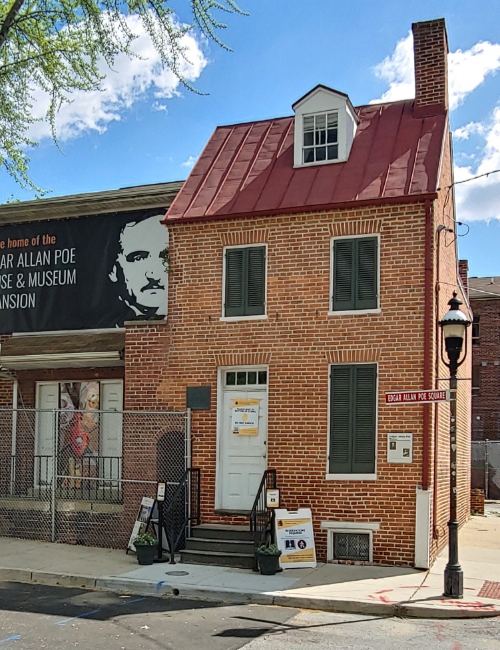
Edgar Allan Poe’s Baltimore house is notable as the site where he began writing short stories. Before that, his published output was poetry. He’s known to have written the stories “Berenice” and “Morella” while living in the house. The former is told from the perspective of a young monomaniacal man named Egaeus. I recently turned the story around and told the story from Egaeus’s perspective. You can find the story in last autumn’s edition of The Hungur Chronicles Magazine available at: https://www.hiraethsffh.com/product-page/hungur-chronicles-samhain-2025
The first thing that struck me about the Edgar Allan Poe house is how small it is. Yes, it’s two-stories tall, but it only has six rooms. A sitting room and kitchen downstairs, two bedrooms upstairs, a tiny loft room and a cellar. I gather Poe lived there with four other people: his aunt, Maria Clemm; her 10-year-old daughter Virginia, who Poe would later marry; her 14-year-old son Henry; and finally, Poe’s bed-ridden elderly grandmother, Elizabeth Poe. It’s not entirely sure who occupied which rooms. The loft was decorated as though it was Poe’s room and it’s believed he did use the room when he first occupied the house, but it’s believed he moved into one of the other rooms when more of the family moved in.
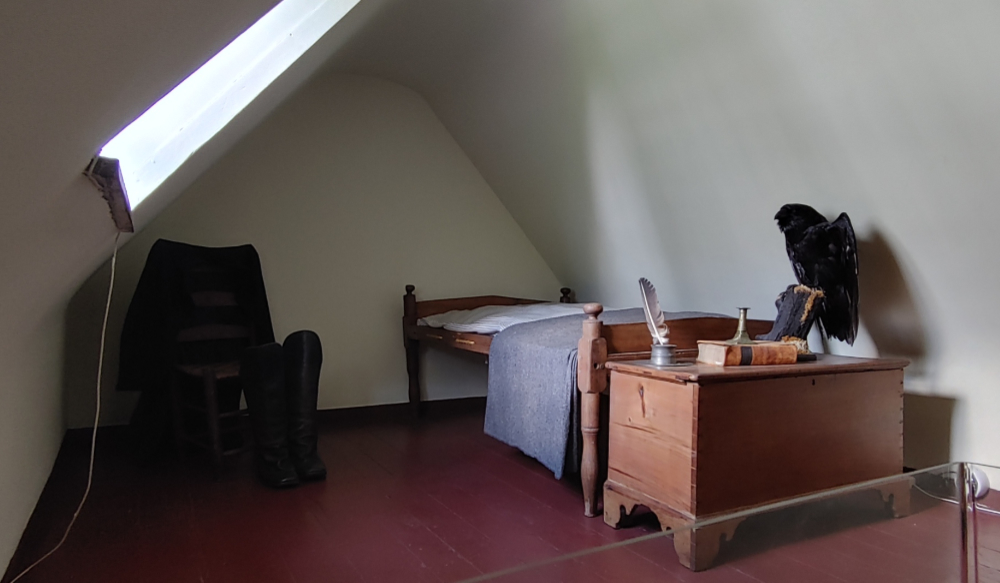
Now, I’m the kind of writer who likes quiet and solitude when I work. I can’t imagine that Poe found much solitude in that cramped and crowded house, even if he did have his own loft room. Still, I could relate to the need to write in spite of difficult conditions. When my kids were very young, I often took an hour a day just to sequester myself at a small quiet desk in my bedroom while they slept so I could get a few hundred words done. Also, in my case, I wrote a lot of poetry in those days because I could a few lines written here and there in the quiet moments. Sometimes, I would make time to leave the house and find a quiet coffee shop to write a few words on my laptop computer. Because of that, I found the display of Poe’s laptop writing desk to be especially interesting.
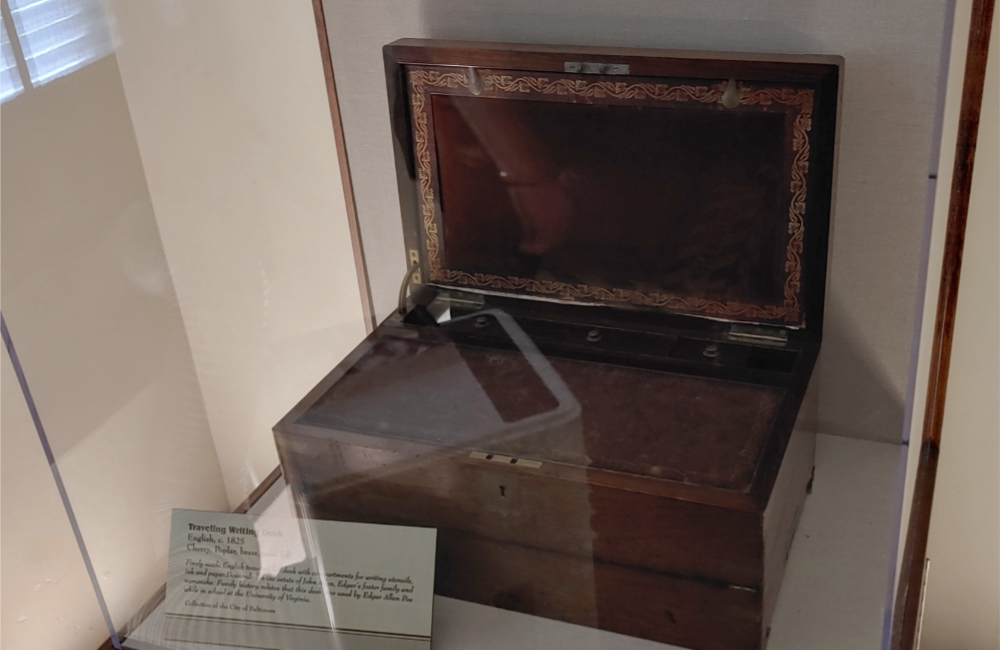
Like laptop computers, most laptop writing desks were placed on desks or tables for use. They allowed a writer to carry paper, pens, and ink with them to write. You could open the top and hang pages to dry and refer to while you worked on the next page. I gather Poe primarily used the desk when he was a student at the University of Virginia. The museum docents couldn’t tell me how heavy the writing box was. I was reminded of the backpack I place my laptop in, but without the convenient straps. The box would have been carried by handles on the side. Still, I wondered if Poe would occasionally take it someplace quiet to work when he needed.
Because I have a job operating telescopes at Kitt Peak National Observatory, the exhibit that really struck me in the museum was Poe’s telescope.
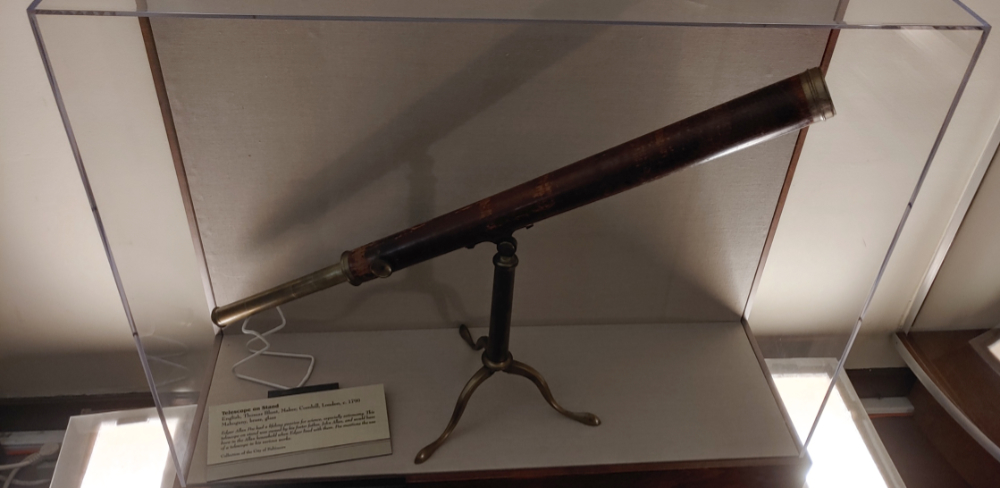
I’ve never really thought of Poe as having an interest in astronomy. However, since I saw the telescope, I began to look into it. According to the Edgar Allan Poe Society of Baltimore, he had an interest in astronomy from childhood. Poe’s 1827 poem “Tamerlane” uses considerable lunar imagery. His 1829 poem “Al Aaraaf,” which is also his longest poem was inspired by the supernova Tycho Brahe observed in 1572. It should come as no surprise that I’ve been inspired by my work in astronomy. In fact, I use supernova remnants as metaphors for ghosts in my horror novel The Astronomer’s Crypt and astronomical objects I’ve observed have appeared throughout my science fiction. I’ve even published several astronomy-related poems.
In the end, I don’t know any more about whether or not I’m really related to Edgar Allan Poe, but I did come away from the experience seeing him as a brother craftsman with many similar interests and experiences. Have you ever visited the home of a famous writer you admired? Feel free to tell me about the experience in the comments.
 Threads that Bind
8 responses to “A Visit to Poe’s House”
How interesting! One of my ancestors was supposedly a British traitor who came over to ‘our’ side during the Revolutionary War. Poe dabbling in astronomy was news to me, and his telescope looks cool – but most of all, I want one of those lap desks! I wonder what folks nowadays would think of that down at the coffee shop. 🙂
LikeLiked by 2 people
I’m with you. I love that portable lap desk. While the designs aren’t quite the same, I did find some folks who sell modern laptop writing desks over on Etsy and they aren’t super expensive as handcrafted wooden items go. Some even have drawers and room for writing implements and paper, like Poe’s did. Still, getting one like the versions from the late eighteenth and early nineteenth century would be very cool.
LikeLiked by 2 people
Hmm, might have to check out those desks at Etsy…
LikeLiked by 2 people
Oh, and by the way, I’ve visited the Hemingway house (which is also now a museum) in Key West. An interesting thing about that experience was I learned there are about 60 polydactyl cats on the museum premises that are descendants of a six-toed cat given to Hemingway by a ship’s captain. Some have extra toes on their front feet, and some on their back feet as well; and some have no extra toes, but they all carry the gene and can birth kittens with extra toes. The museum staff care for them.
LikeLiked by 2 people
That’s cool. I’d definitely enjoy visiting the Hemingway house. One of my collaborators lives down in the Keys, so it would also give me a chance to stop by and say hello!
LikeLiked by 2 people
Veeeeery interresting! Poe has always been a personal favorite of mine. Back when we were beginning to be exposed to the classic authors ~ the crashing bores to my mind ~ that fifth grade teacher that I’ve talked about with fondness brought in some small books by a different sort of classic author, and exposed us to The Raven and The Pit and the Pendulum. Went on from there to discover Wells, Burroughs, Haggard, Stevenson, and a good many more who showed me that the classics could have entertainment value after all, but Poe was the first, and there’s a special place in my reader’s heart for him.
LikeLiked by 1 person
It was my brother who introduced me to Poe’s works when I was in elementary school. He read the Raven to me when I was in fifth grade or so and I’ve been hooked ever since. My ninth grade science teacher tried to suck the fun and suspense out of “The Tell-Tale Heart” by analyzing it into an early grave, but still, I saw things I hadn’t seen in a surface reading, which was cool. One of the things I gained from Poe is an appreciation of the short story. It took me a while to get my head around the structure, but for me, it lead me to more modern masters of the form like Ray Bradbury and Harlan Ellison, who both entertained me and often gave me something to ponder on dark and dreary nights.
LikeLiked by 1 person
[…] house in Baltimore, Maryland. I shared some of my thoughts about the visit last week over at Threads that Bind. One of my souvenirs from the visit was a copy of the graphic novel The House of Montresor written […]
LikeLike