When Jack Tyler invited me to join the rotation here, my first response wasn’t excitement.
It was hesitation.
“I don’t know,” I told him (at least in my head: never trust a fiction writer). “I don’t really think of myself as a horror writer.”
That probably sounds strange to anyone who’s read my fiction. Death shows up with suspicious regularity. Monsters wander through my stories. Human beings do terrible things to one another. Strange occurrences refuse to explain themselves. There are ghosts of one sort or another hiding in the wallpaper.
Still, when I picture a horror writer, I instinctively imagine someone else.
I’ve been reading this site for some time now. Long before I ever had an invitation to contribute, I was one of those quiet subscribers lurking in the comments. I’ve known several of the names here for a long time now, and Jack and I have traded thoughts back and forth over stories and essays through comment sections for the better part of a decade.
So when he offered me a place among writers I respect, my first concern wasn’t whether I wanted to do it.
It was whether I belonged.
The more I’ve thought about that question, however, the more I’ve started wondering if maybe I’ve been looking at horror through too narrow a keyhole.
I’ve always loved stories that lived just outside ordinary reality.
As a kid, my imagination was shaped by The Twilight Zone, The Outer Limits, and Star Trek. Later came Kolchak: The Night Stalker, The X-Files, Buffy the Vampire Slayer, Angel, Lost, Fringe, Supernatural, The Walking Dead, and Evil. Some of those series lived squarely in horror. Others wandered through science fiction or fantasy. Most ignored the borders altogether.
That always felt natural to me.
Science fiction, fantasy, horror, mystery—they’ve never occupied separate shelves in my imagination. They’re neighboring houses on the same dark street. This is a website that also lives on that street.
The science fiction I devoured as a kid wasn’t particularly fashionable, even then. The Lancaster County Public Library had shelves filled with Golden Age science fiction, so I grew up reading Asimov, Silverberg, Heinlein, Philip K. Dick, Harlan Ellison, Ray Bradbury, Richard Matheson, and countless anthology collections whose individual authors I’ve long since forgotten.
Then came Dean Koontz, discovered from a drugstore paperback spinner rack. Stephen King’s The Stand, which remains one of my favorite novels ever written. Poe. Lovecraft. Peter Straub. Joe Hill. Charles L. Grant. Neil Gaiman. Bentley Little. Richard Laymon.
Somewhere along the way I reached the depressing realization that many of the books that felt wonderfully modern when I was a teenager are now considered classics.
The wheel turns.
Looking back, though, something else occurs to me.
Very little of what I loved fit neatly inside a single genre.
Those stories borrowed freely from one another. Science fiction became horror. Horror became fantasy. Detective stories became supernatural mysteries. Sometimes they all happened at once.
Maybe that’s why my own fiction has always refused to stay inside one fence.
I’ve certainly written monsters.
Some had claws.
Some had fangs.
Some came from somewhere beyond our understanding.
The monsters that linger with me longest, though, are the ones carrying driver’s licenses. Humans frighten me in ways vampires never quite manage. Fantasy monsters are wonderfully entertaining because they’re impossible. Human cruelty is terrifying because it isn’t.
I’ve written scenes involving violence, blood, and enough unpleasant imagery to make readers wince. If history is any indication, I’ll probably write more.
But I’ve gradually realized that gore isn’t what scares me.
Fear is.
Those aren’t the same thing.
A coroner can stand over an autopsy table all day without experiencing horror. I hope, anyway. At some point familiarity changes the equation. Blood becomes evidence. A body becomes a case.
Likewise, jump scares eventually lose their effectiveness. Enough buckets of fake blood eventually become almost funny.
Fear, however, never grows old.
Consider Jaws.
Bruce the shark is famously absent for much of the film. Mechanical problems forced Steven Spielberg to keep the shark hidden, and cinema became better because of it.
The shark is everywhere even when he isn’t on screen. He’s present while men compare scars below deck. He’s present while the ocean lies perfectly calm.
John Williams’ score reminds us that something enormous is moving beneath the surface, even when we can’t see it.
That’s fear.
The unseen possibility. The waiting. The certainty that something is wrong before we know exactly what.
For me, that’s where horror reaches its purest form. I’m not quite arrogant enough to try to define what horror is to a group of horror aficionados. I won’t hesitate to tell you how I’ve defined it for myself.
I could write a page describing a gruesome murder in explicit detail. It might even make someone squirm.
But here’s the image that actually gives me gooseflesh.
Imagine you’re home alone.
You walk into your bathroom.
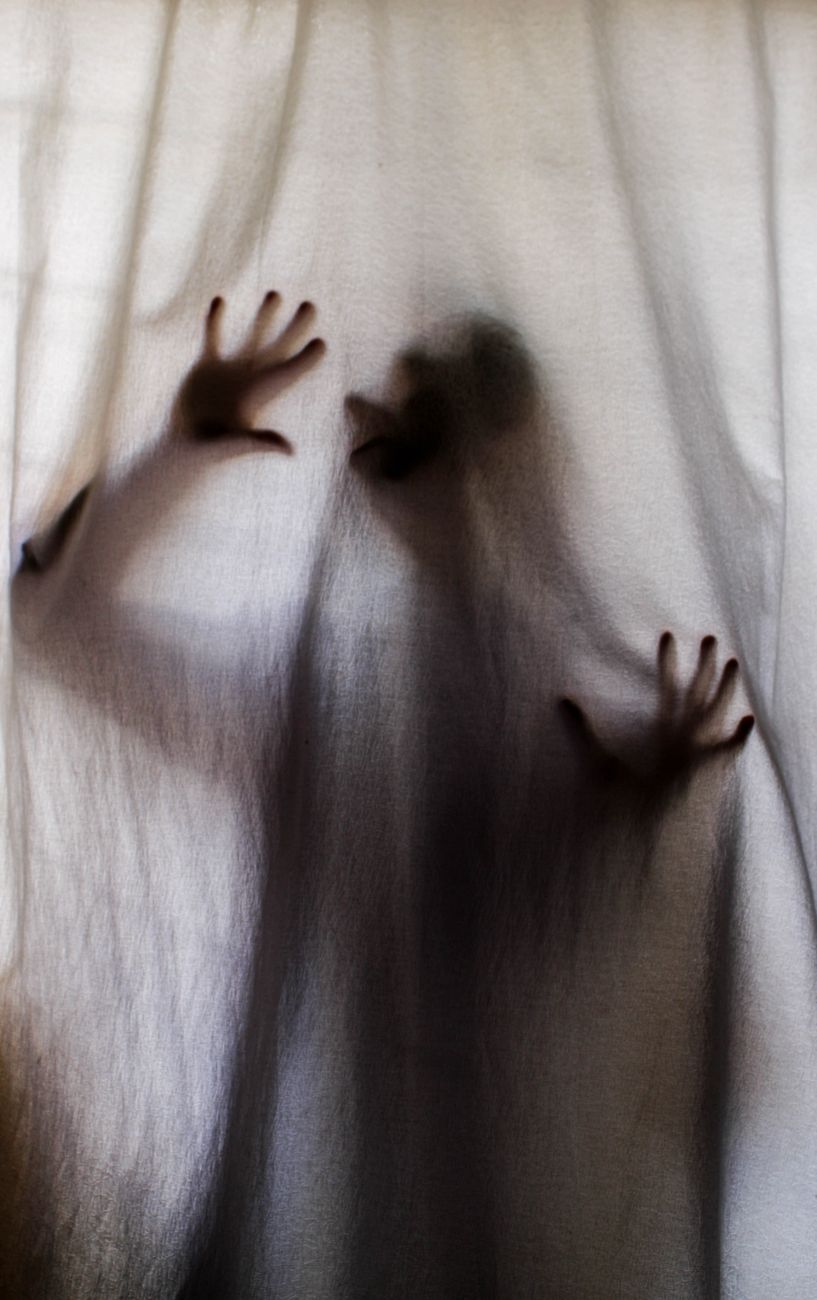
The shower curtain is closed.
You don’t remember closing it.
And suddenly you’re wondering whether someone is standing behind it.
Someone holding the butcher knife that used to be sitting in the wooden block on your kitchen counter.
There’s no blood.
Nothing has happened.
Yet.
Your heart is already racing.
That, to me, is horror.
Fear of the dark.
Fear of the unknown.
Fear of opening the wrong door.
Fear of the woods—especially if you’ve spent your whole life in cities.
Fear that someone you love has been lying to you for years.
Fear that your spouse is planning to kill you.
Fear of losing your spouse or child.
Fear that the comforting stories you’ve always believed about your family, your government, your church, your history, or yourself turn out not to be true after all.
Maybe that’s why I’ve always loved the paranoid stories of the 1950s.
The Cold War produced a remarkable strain of fiction built on suspicion itself. Every closed blind concealed a Communist spy. Every smiling neighbor might be something else entirely.
Invasion of the Body Snatchers.
Village of the Damned.
The Thing.
What if the monster looks exactly like us?
What if the conspiracy theories are true this time?
What if there really is a hidden fraternity quietly dismantling civilization from within?
What if Rosemary really is carrying the child of Satan?
None of those stories begin with gore.
They begin with doubt.
With unease.
With the tiny crack that appears in our certainty before the whole foundation collapses.
That’s fear.
And perhaps that’s the realization that finally convinced me I do belong here after all.
Maybe horror isn’t defined by monsters. Maybe it’s defined by what keeps us looking over our shoulder after we’ve turned out the lights.
It’s the hesitation before reaching for the shower curtain.
The glance into the tree line while walking back to the car.
The suspicion that someone, somewhere, knows something we don’t.
The quiet certainty that the world is just a little stranger—and a little more dangerous—than we’d like to believe.
If that’s true, then perhaps I’ve been writing horror all along.
I just didn’t call it that.


One response to “Am I a Horror Writer?”
Allow me to answer with a resounding YES! You understand the concept. Horror isn’t defined by monsters, the undead, space creatures, or serial killers. It is defined by how unsettled you can make your singular reader, and that is done by tickling the fear response. Brilliant and insightful, my friend. Welcome to the fold!
LikeLiked by 2 people