Just over a month ago, I said goodbye forever to my best friend, my wife of thirty-six years, Kumie Wise. Less than a week before she passed, we learned that the breast cancer we thought she’d beaten back in 2011 had metastasized with a vengeance and was attacking her lungs and bones. It’s hard to think of a more fearful villain than those mutated cells that can form within our own bodies and attack us from within. My daughters and I were with her when she passed, reading one of her favorite novels. I’m glad we were able to be there for her in her final moments even though it was the most profoundly sad time I can remember.
We all have to deal with death at some time or another. Unless someone reading this has cracked the secret of immortality, we all have to face our own deaths at some point. I think it’s one of the reasons many of us turn to horror fiction. As fiction it’s a safe zone for us to examine death and process our reactions to it. By complete coincidence, right around the time my wife passed, Aaron Mahnke’s fine book Exhumed was published. The book purports to be a history of the American vampire, but it’s actually much more. It looks back and examines the way we have viewed death, the soul, and how vampire legends came to be in the first place.
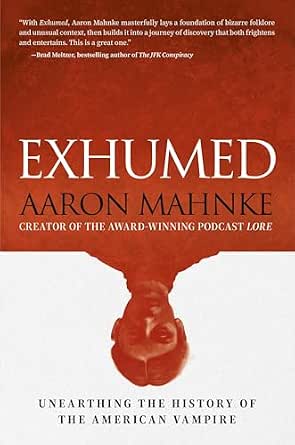
The book begins its narrative at the end of the eighteenth century. As befits a story about death in America, Mahnke opens with a story about the death of George Washington. As also befits a history about vampires, he opens with a discussion of blood. Specifically, Mahnke discusses the reasons doctors once engaged in bloodletting and how around that time, doctors began to think that transfusions of young, healthy blood might help people recover from serious illness. Now, this is still before the properties of blood were as well understood as today. There’s still a sense that blood had some magical, mystical properties that lost potency over time. However, it’s also an age where people were studying the way the human body worked and beginning to make the first strides toward medicine as we know it today.
From there, Mahnke takes us on a journey to how doctors began to understand the human body as a mechanical marvel and from that point noted such things as how electrical currents could make even dead muscles move. From that revelation, doctors began to think that perhaps they could put together tissues themselves an infuse them with life. If you see how these revelations might have influenced a young Mary Shelley, you’re on the same track as Mahnke is in his book. What’s more, as you introduce blood and reanimating dead tissue, you can see why Shelley referred to the monster as a vampire at times.
Another topic Mahnke explores is so-called “corpse medicine.” The idea here is that as we age, our bodies lose certain vital essences and that in many parts of the world, it was believed that consuming parts of someone who died young might actually give you some of that vitality back. In Europe, for example, it was not uncommon for the infirm or critically ill to be given blood from the body of an executed criminal – the younger the better – as a sort of tonic. Of course, this has clear ties to how vampires restore their vitality through the drinking of blood.
Mahnke then moves on to the fear of premature burial which largely came about because the process of bodily decomposition was not well understood. We now know that as gasses are released during the decomposition process, they can cause the body to move within coffins. We know that the withering of the epidermis can make it appear that hair and fingernails have grown. Back in the day, the decomposition of blood, in particular, was considered a straight-line process of drying liquid. It turns out, it’s much more complex in the early weeks of death and can lead to blood still being liquid in parts of the body many weeks after death.
Mahnke concludes his book with an examination of Mercy Brown, a young woman who died of tuberculosis at the end of the nineteenth century and was exhumed because people believed she was a vampire, spreading disease among her family and the people of the small town of Exeter, Rhode Island. Exhumed puts Mercy Brown’s story firmly in the context of its times and explores how folk beliefs about medicine and vitality came about. In the days before tuberculosis was understood to be a scary bacteria attacking our bodies from within, Mahnke shows us how it could look like members of a family or a small town were being haunted by some malign force draining them of their vital essence. In many parts of the world, that malign force was seen as a vampire.
As a writer of vampire fiction, Mahnke’s book did remind me that many folktales about vampires don’t resemble Bram Stoker’s famous account at all. They’re often much more intimate stories about vampires coming for loved ones. Often such stories take place on farms or in small villages. Stoker turned the story around a bit by making Dracula an aristocrat, when most vampires of folklore were simple people of the land.
Exhumed by Aaron Mahnke is highly recommended for writers who want to pursue horror set in historical times, want to understand where some of our beliefs about death come from, or just want some background in how we’ve come to better understand the process of death and disease. As with any good non-fiction work, Mahnke includes a thorough bibliography for those who want to delve into the subject more deeply. Find the book at your favorite store.
Also by coincidence, the last piece of fiction of mine my wife read before she passed was The Enduring Frankenstein, which imagines Victor Frankenstein’s younger brother Ernest fighting to save his true love, Elizabeth Lavenza, from the clutches of death itself. To be honest, it’s a little prescient for comfort, but hopefully it’s a good yarn. You can read the story if you subscribe to my Patreon at https://www.patreon.com/cw/davidleesummers


2 responses to “Exhumed”
David, sorry to hear about your wife and sorry for your loss. In the real world, there is indeed no greater villain than cancer.
LikeLiked by 2 people
Thank you, Garrett. I really appreciate that.
LikeLiked by 1 person