Welcome once again to the inner ramblings of my fractured, meandering mind. I am currently having some further musical thoughts, specifically regarding universal music this time around.
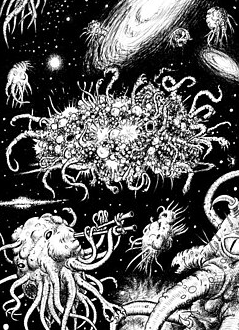
Also known as ‘Music of the Spheres’ and ‘Harmony of the Spheres’, ‘Musica Universalis’ is a philosophy that postulates that mathematical aspects of the movements of celestial bodies could comprise a form of music. It began with the ancient Greek philosopher and mathematician Pythagoras. Based on his observations of numerical ratios formed by intervals between harmonious sound frequencies, he proposed that the Sun, the Moon, and the planets could emit unique sounds created by their orbital mechanics; and although those sounds might be inaudible to human ears, life on Earth could nonetheless be impacted by this celestial music.
Plato considered astronomy and music to be twin disciplines, the former for the eyes to perceive and the latter for the ears, as mathematics underlie both pursuits and there is supposedly overlap between them in terms of interrelated numerical proportions. He further believed that mathematics underpins all of reality, and that the universe is a living, harmonious whole governed by mathematical proportions. Astronomy thus illuminated the visual harmony of the cosmos, while music expressed its audible harmony.
Aristotle later rejected Pythagoras’ assertions on the basis of loud noises of certain frequencies being capable of shattering solid objects (think a soprano’s amplified voice shattering a wineglass), and he thought that sounds made by massive bodies like planets and stars would have to be immensely more forceful and destructive despite them being inaudible to us. But the 16th century astronomer Johannes Kepler further developed the concepts of Pythagoras using his Third Harmonic Law to derive planetary frequencies and map them to musical pitches; and though he too believed that this music would not be audible to human ears, it could be heard by the soul.
Modern musical recordings exist that simulate the Music of the Spheres in human-audible range using astronomical proportions, the numeric ratios that Pythagoras and Plato associated with cosmic harmony, and/or planetary orbital ratios based on Kepler’s Harmonic Laws. There are also recordings that include or feature radio emissions from various celestial bodies that are generated by magnetic fields. Some of these recordings are more ‘artistic’ than others, and people use some of them for palliative purposes such as meditation. And then there are devices such as subwoofers and tactile transducers (‘butt shakers’), which allow infrasonic bass tones to be felt even though they’re below the audibility threshold of our ears; when attached to a chair, the vibrations from the device are initially felt and then transmitted through our body in a manner similar to the bone conduction that occurs in our inner ears. All this made me wonder if Pythagoras and Kepler could have been right. Could technically inaudible sounds (such as those produced by the Music of the Spheres?) indeed affect us without us consciously realizing it?
And then, this being the type of blog that it is, I also thought of H.P. Lovecraft’s Azathoth, the blind idiot god that is the eternal nuclear chaos beyond time and space at the center of infinity, whose court (according to old H.P.) is populated by “mindless Other Gods” dancing absurdly to “the muffled, maddening beating of vile drums and the thin, monotonous whine of accursed flutes… whence flow the aimless waves whose chance combining gives each frail cosmos its eternal law.” (Incidentally, Plato may have provided Lovecraft with some inspiration for this, as he thought of the cosmos as a musical instrument with a divine Demiurge ‘singing’ the universe through harmonic proportions.) If an entity akin to Azathoth, or Plato’s Demiurge (or God?) really exists, could its music have resulted in the creation and direction of our universe, and could that entity be subliminally or even physically influencing people directly right here on Earth as we speak—perhaps via the Music of the Spheres? Beats me, but I guess it could be food for thought.
Finally, I wondered what the music of Azathoth’s court might sound like if we could hear it. Experimental acid jazz, perhaps, or some other form of avant-garde music? Frank Zappa playing his bicycle as if it were a musical instrument while accompanied by a cacophonous outburst from the stage orchestra on Steve Allen’s variety show back in 1963? Some modernist classical compositions might come close, such as the beginning of Stravinsky’s Rite of Spring; or maybe the orchestral crescendo in the Beatles’ A Day in the Life. If we could hear, or otherwise perceive, Azathoth’s accursed music, would it drive us mad?
To find out, I asked an AI chatbot to help me simulate what the music of Azathoth might sound like it if it were audible to us. We started with some tracks based on Pythagorean harmonic ratios and Keplerian planetary orbital ratios (specifically Mars and Saturn), and then added some flute and drum elements. I didn’t think the AI’s output was chaotic enough, so I further manipulated the tracks using my DAW (Digital Audio Workstation). (DAW software has grown so sophisticated that one could diddle at this sort of thing forever with a seemingly limitless variety of permutations of instruments, options, and effects—so I just played around with it for a while and then made myself stop.) Anyway, here’s a clip of my results if you’d like to hear them:
In conclusion, has listening to all this strange music in fact driven me mad, or am I just being my usual weird self? There are perhaps better efforts than mine floating around out there in the ether, if you want to hear more. Will it drive you mad if you get in the habit of listening to this kind of ‘music’? Try it and see, if you dare!
OMMMMMMMMM…
 Threads that Bind
3 responses to “MUSICA UNIVERSALIS”
This is fascinating.
LikeLiked by 2 people
I never really understood what the Music of the Spheres referred to, beyond some far out synthesizer compositions of the sort that accompanied parts of Sagan’s Cosmos. Now, thanks to your simple explanation, I feel much more knowledgeable. And, given its origins, how could it not be connected to the works of Lovecraft?
LikeLiked by 3 people
The part about Lovecraft and Azathoth’s accursed music really got me. I actually did try the Azathoth simulation, and I have to say… it’s extremely disturbing. I can definitely understand why something like that might drive someone mad.
It also reminded me of an episode of Stargate SG-1 where an alien takes human form and starts enjoying our music while gradually becoming unable to stand the music of his own people. Maybe there’s something unsettling about becoming attached to a sound that was never meant for us. As for whether this kind of music can drive you mad… I tried it. I’m not sure I want to try it again.
LikeLiked by 2 people