Time travel stories are a natural substrate of horror. Horrible things happen when you fool around with the temporal order, which is probably why I don’t much care for it as a subgenre. I get lost easily, finding myself confused about when I am in the flow of time, and don’t get me started on the paradoxes! There’s a chance, one I’d like to find was true, that this says more about the skill of the author than my ability to follow a story, but that’s just semantics; the result is the same either way.
The fact that I don’t like it doesn’t mean it isn’t popular. Just to check my facts, I paid a quick visit to Goodreads and requested a list of time-travel books. It took one-tenth of a second for it to deliver 1,530 results. People do seem to like it. And, just to show there are always exceptions that prove the rule, there are two that blew me away. One is well-known to virtually anyone who reads or watches science fiction: The Time Machine by H.G. Wells. The other is a bit more obscure, and that’s what I’ve come before you to talk about today. Despite being published in 1967, it is still in print and available today on Amazon, Barnes & Noble, and likely a number of other outlets. If it wasn’t, this would be pretty pointless.
(Henry) Kenneth Bulmer lived for 84 years, and published under more than a score of pseudonyms. A British author, he was one of the most prolific writers of the so-called Golden Age of sci-fi, publishing over 160 novels and 200 short stories. In a cover comment on a recent reissue of this book, he is called, “One of the definers of yesterday’s tomorrow.” I knew none of this when I bought this book from a spin rack in 1967.
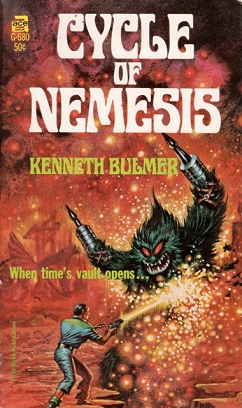
Trapped in the terminal of Travis Air Force Base awaiting a space-available flight to Guam, sleeping on my seabag, and living on chips from a poorly stocked vending machine, I thought perhaps an engrossing book might stave off the looming insanity. The selection was poor at the rudimentary gift shop, but this lurid cover caught my eye, and for the princely sum of 50¢, I made it mine.


K. Bulmer, ca. 35 ~ K. Freas, ca. 82
I must offer a footnote on said lurid cover: No credit is given to the artist anywhere in the book, but this is the age of the internet, and I managed to discover that this was the work of one Kelly Freas. Perhaps not the household name that Boris Vallejo or Frank Frazetta would become in the years to come, but Freas was indeed a big deal, being called the “Dean of Science Fiction Artists,” and producing covers for such pioneering publications as Weird Tales and Astounding Science Fiction. He served in the South Pacific in WWII as an aerial photographer, and among his other duties, painted pin-up girls on the noses of the bombers he was stationed with. He was only the second artist inducted into the Science Fiction Hall of Fame.
Okay, so it was 1967 and I wasn’t sophisticated like I am now, but this story grabbed me by the throat and didn’t let go until the wheels had come to a stop at Anderson Air Force Base on Guam. Not even Brannif’s smokin’-hot, mini-skirted stewardesses could break my immersion. I’ll freely admit that I was a drooling horn-dog at 18, so there is likely something to learn from this book about holding a reader’s attention. Here’s the blurb:
“Seven thousand years ago one of Earth’s earliest civilizations was confronted by a menace from the stars — and died in a world-shaking effort to destroy that cosmic monster. But the death of that forgotten empire was not in vain, for they did succeed in entombing that dimension-shaking thing out of sight and harm to humanity.
“But even their efforts could not make that burial permanent — and after seven millennia the monster stirred again, cracking through the time-weakened barriers to assault the new world of today”
That’s a bit misleading, but I can forgive a copywriter whose job is to sell books. The creature, Khamushkei the Undying, has not fully broken free, but it can manipulate time through the weakened restraints, and send out its minions, one of which is portrayed on the cover. Nasty stuff indeed. Clues dropped in the narrative suggest that the early civilization may have been the Sumerians, but we are assured that it predated even that.
The main characters are a group of five men and women, only two of whom know each other at the start. The first-person narrator and his good friend are at the auction of a major estate. They’re hoping to buy a smaller piece or two, but this sale has attracted Big Buyers, and they don’t think much of their chances. In the early stages when prospective buyers can wander freely and examine the items for sale, the narrator, Bert, sees his twin (spoiler: he doesn’t have one) hiding from something in a stairwell. The man wears a gaudily decorated Corinthian helmet, and doesn’t respond when Bert speaks to him. They meet a woman who’s come hoping to buy a dollhouse, and as they talk, a second woman appears in the hallway, running in terror from one of the aforementioned minions, but before they can even react, woman and monster disappear into thin air.
Bert has purchased an antique globe, but is immediately approached by a man offering Bert twice what he paid for it so he can destroy it in the hope of finding something inside. For twenty years he has been on the trail of Khamushkei the Undying, and he believes a vital piece of data has been secreted within the globe. Before they know it, they are being hurled backward and forward in time and hunted by the monsters as Khamushkei seeks to keep them from solving the puzzle whose solution is the means to trap him for another seven millennia.
This fifty-cent pulp novel with the leering monster gracing its cover has pages that have yellowed and turned brittle to the point that it’s risky to try to turn them to read it. I could easily replace it, it still being in print and available, but this book has been my boon companion for 59 years. I kept it with me on Guam, dropped it off at home before I went back to sea, and read it nightly to my wife as we prepared for sleep; it will not be tossed aside so easily.
I think the attraction is the way the author was able to maintain focus on the main issue even as his characters were being thrown to and fro through time and assailed by creatures beyond imagining. I haven’t been able to crack the code and make my own stories so riveting that you can’t look away, but maybe you can. At the very least, you’ll be in for a helluva ride! You can thank me later.
 Threads that Bind
4 responses to “It’s About Time”
Wow. This is a good blurb for the novel and I feel I must fill that particular gap in my Golden Age reading list. A good book always stays with you, doesn’t it?
LikeLiked by 1 person
Glad I could convince you! It’s one helluva ride, and I think you’ll enjoy it. Thanks for stopping by.
LikeLiked by 1 person
I’d never heard of Bulmer, so thanks for enlightening me. And speaking of time travel paradoxes, have you ever heard of the Block Universe Theory? Einstein showed that time is relative and can speed up or slow down depending on velocity and gravity, which means there is no universal ‘now’ moment. The BUT interpretation of Relativity proposes that the past, present, and future exist simultaneously and are interconnected, and time is just a spatial dimension that our brains perceive as being linear in an attempt to make sense of it all. (Just thought I’d throw that in to muck things up a bit.) 🙂
LikeLiked by 1 person
Welcome, Garrett, and thanks for stopping by! Happy to have turned you on to Mr. Bulmer, and should you pick up this book or any of his others, I hope you have an enjoyable ride. I’ve heard a number of theories on the mechanics of time, most of them conflicting, and most incomprehensible to someone of my educational level. I like learning about space, including time-dilation, but “time and how to tweak it” as a subject leaves me cold, and I’m never going to be friends with it! Always nice to chat with you, though.
LikeLiked by 1 person