The recent movie The Bride opens with Mary Shelley’s spirit talking about writing a sequel to her most famous novel of all. She says, “The words are beginning to come. Is it a ghost story? A horror story? Or most frightening of all, a love story?” This question could be asked about the original novel. You can even toss in at least one more question. Is it science fiction. As it turns out, I recently did a deep dive into Mary Shelley’s novel and I’ve been thinking about this very question. Just what kind of novel is Frankenstein; or, The Modern Prometheus? Let’s take the questions more or less in turn.
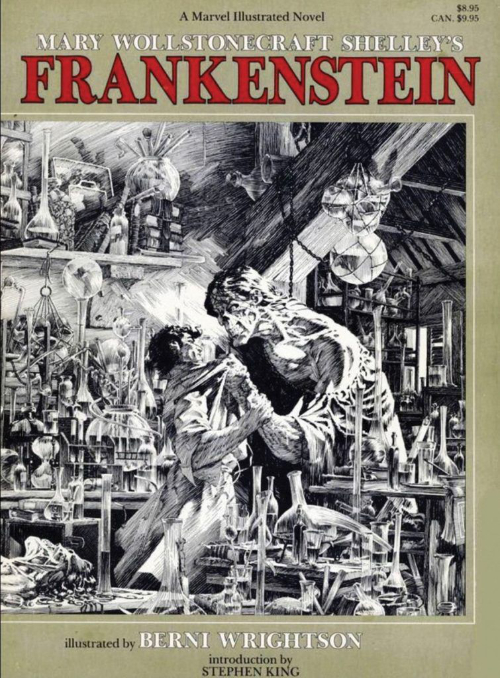
Is it a ghost story?
Frankenstein was first conceived in 1816 when Mary Godwin traveled to Villa Diodati on the shores of Lake Geneva in Switzerland with her soon-to-be husband Percy Shelley. They were guests of Lord Byron and his physician Dr. John Polidori. Also on hand was Mary’s stepsister Claire Clairmont. The summer of 1816 proved especially rainy, trapping everyone inside, so Lord Byron proposed that everyone create a ghost story.
Dr. Polidori’s story became the novella The Vampyre, which many consider the progenitor of the modern vampire novel. Of course, Mary’s story became the basis of the novel we now know as Frankenstein. Her notion was that this creature reanimated from dead tissue became a sort of specter haunting its creator, Victor Frankenstein. It tormented him from the shadows, appearing when it was not expected. When it does appear, it’s aspect is frightening and people are afraid.
The creature first manifests as a wraith on the ice, viewed in the distance by the crew of a ship bound in the ice as they try to reach the North Pole.
The monster even literally “haunts” a small house in a village near where he was created. Listening in, he learns language from the old blind father who inhabits the house with his children. He learns how to read and write. He is like a friendly spirit and does favors for the family in the house, bringing them firewood. However, when he does appear, he’s treated as a monster and he’s run off.
Like a ghost, the creature has unresolved issues he wants answered before he can “move on” in whatever form that might take. He wants to understand why he was created. He would like another him to make his loneliness more bearable.
Is it a horror story?
Unlike most ghosts, the creature in Frankenstein is not content to lurk in the shadows and scare people when he “manifests.” He shows himself quite capable of killing. When he reaches Victor Frankenstein’s hometown of Geneva and finds the Frankenstein estate, he kills Victor’s younger brother William and then frames a beloved servant for the murder. When Victor refuses to see the creation of the creature’s companion through to completion, the creature captures Victor’s best friend, Henry Clerval, and kills him. Finally, the monster kills Victor’s bride, Elizabeth, on their wedding night.
The creature’s ghost-like appearance means you never quite know when he’s going to strike and that aspect of the novel makes it frightening. Even the creature’s very creation is frightening as Victor visits resurrectionists and digs up graves to find the parts he wants to build his “ideal” man and then used galvanism to bring him to life. The details of this process are not specified in the novel, but you have enough that you can see the creature as a sort of zombie or even, as he’s called a few times in the novel, a vampire. He’s pieces of multiple corpses stitched together and given life. As soon as Victor creates the creature, he regrets it and he lives in dread of encountering it again.
The horror of creating the creature comes back in full force when the creature demands that Victor build him a companion. Victor disappears to the Orkney Islands to engage in his task, but realizes the full horror of what he’s doing and destroys his second creation before completing it. This sets the creature on a path of revenge, killing Henry and Elizabeth.
Is it science fiction?
Mary Godwin was aware of experiments that had been conducted where scientists applied electrical charge to muscle tissues, such as to frog legs, and saw them move. Like any good science fiction writer, she took the idea and ran with it. What if a scientist attempted to use galvanism to not only make a dead man walk again, but bring it to life? Also, like any good science fiction writer, Mary looked at the consequences of those actions.
She also explores another aspect of science from her day. The novel is framed by the story of an expedition to reach the North Pole. In the time the novel was written, many explorers attempted to reach the poles, to understand how ocean currents worked around the poles and how the poles influenced weather. Of course, they also sought paths through the ice, hoping their might be a usable trade route.
Is it a love story?
At first, this may seem like an obvious “no” but allow me to throw a few things out for consideration. An important plot element is that Victor Frankenstein is engaged to be married to Elizabeth Lavenza. Of course, Victor himself is quite preoccupied with his creation throughout the story. Even so, t’s clear that he cares for Elizabeth and wants to assure she’s safe.
Let’s also not forget the love story between Felix DeLacey and Safie. Felix is the son of the blind man in the cottage that the creature “haunts.” Safie is a Turkish woman. The fact that Felix teaches Safie to read and write French is part of how the creature learns to speak. The creature also learns that he would like a companion from watching Felix and Safie.
Of course, another major plot element of the novel is the creature’s desire for a companion. We never get to love expressed between the creature and the companion because Victor destroys her before that can happen.
Finally, because the creature can be seen as the child of Victor, we see the creature’s desire to be loved by his creator. Of course, Victor never returns that love. He runs in terror from the creature. So at its heart, Frankenstein can be read as a cautionary tale about how dangerous it is to turn away from your own child and not show them love and affection. The anti-love story can also be read to some degree in Victor and Elizabeth’s relationship. Instead of taking time to love and cherish Elizabeth while he can, he puts off the marriage until he dispatches the creature, which proves to be a tragic mistake.
So, what is Frankenstein?
I’d argue that Mary Godwin, who would become Mary Shelley, introduced elements of Gothic horror, ghost stories, and even romance to create Frankenstein. Often, she’s credited as the mother of science fiction as well. Although I’d argue there are earlier works that could also be called science fiction, hers is the best and the one that feels the most like science fiction as we discuss it today.
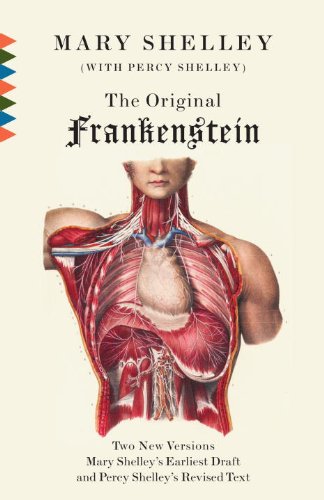
Recently I made a deep dive into the text of Frankenstein by reading a book entitled The Original Frankenstein edited by Charles E. Robertson. The book presents the oldest surviving manuscripts of Mary Shelley’s Frankenstein and also explores Percy Shelley’s contributions to the novel. Not only did that deep dive inspire the thoughts that led to this post, they also inspired me to write a novella, which I call The Enduring Frankenstein. It’s the story of Victor’s brother Ernest, who is the only member of Victor’s family to survive the novel’s events. I’m serializing the novella at the rate of a chapter per week over at my Patreon page: https://www.patreon.com/cw/davidleesummers
If you’d like to read, you can join for free with a trial membership. The first chapter is live and the second one will be live today. If you like what you read, you can stick around for just a dollar a month and see how it ends. I hope you’ll join me there.


2 responses to “What is Frankenstein?”
An intriguing analysis! And your ‘The Enduring Frankenstein’ sounds interesting. It adds another facet to an already complex tale. I’ll have to check that out.
LikeLiked by 2 people
Thank you, Garrett. I’m sure I just scratched the surface of what could be seen in the novel. In fact, my daughter took a whole college course inspired by Frankenstein! Hope you enjoy The Enduring Frankenstein when you get a chance to check it out.
LikeLike