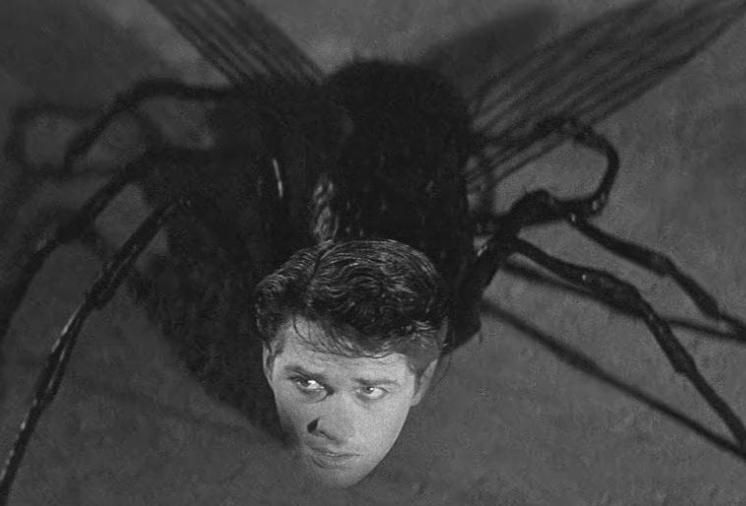
Do you remember the fly with the human head trapped in a spiderweb and screaming for help in the 1958 horror film THE FLY? Well, we writers are becoming increasingly trapped in a web created by Artificial Intelligence. Should we also be screaming for help?
You see, AI is now writing books. I imagine you already knew that – but do you know the extent of it and all of the ramifications? While there’s no clear statistical evidence (yet) that human readers have come to prefer AI-written fiction over human-written fiction en masse, it’s also true that in blind tests employing short passages, many people can no longer tell the difference. When adults are told beforehand which is which, moral and ethical biases against the AI creations come into play; but these biases don’t exist in the minds of most young readers, who are more accepting of AI-generated works.
For longer works at least, publishing industry surveys show that mature reader preference still leans toward human-written fiction, especially in literary fiction, horror, romance, and character-driven genres in general; i.e., genres in which voice, originality, and emotional depth matter. But that said, fully AI-generated fiction is growing and gaining acceptance, albeit mostly in niche categories like short-form genre fiction, fan fiction, pulp fiction, serialized Web fiction, and gaming fiction, where speed and formula are more important than literary qualities.
But even that is not the end of the story. There’s now another plot twist developing, and rather rapidly. This is Hybrid Fiction, which is fiction that’s technically human-written but AI-assisted. The AI assistance in this kind of collaboration can range from simply using AI to help brainstorm, to prompting AI to help with the actual writing and then editing the results. Another twist is, even if we don’t personally use it, AI is also impacting our writing through the sheer volume of AI-assisted output; and it’s reshaping not only how books are written, but also how they’re discovered and marketed. Amazon alone is publishing over two million books a year now, and AI tools are accelerating that growth. Authors can now write and format books in days instead of months, and micro-genres are being flooded with AI-assisted low-content, niche romance, and short thriller titles. Amazon policies and algorithms strongly favor AI-assisted over fully AI-generated works, which means AI-assisted hybrid writing is becoming the norm, especially for niche and mid-tier indie authors.
This means the competition is growing stiffer and visibility is becoming even harder to achieve. Metadata optimization and category strategy are now more important than ever, as are book descriptions and covers. But don’t worry, there are AI tools to help with all that as well. AI cover generators can produce genre‑accurate book covers in minutes; there are tools for creating posters and video trailers; and tools like KDP category finders and listing optimizers. These are all now essential for serious indie authors. If such authors want to sell books, AI‑optimized marketing has become just as important as the writing, if not more so. Ignoring AI in the hope that it will go away is no longer a viable strategy. And let’s not forget that there’s still marketing value in personally connecting with reading audiences through regularly scheduled creative and interesting emails, social media posts, podcasts, etc. (and blogs!), all of which we should also be pursuing – and all of which take up even more of our time.
Personally, I’m finding the whole business kind of mentally exhausting. I don’t need to make a living from my writing, and I don’t relish the idea of spending as much time (or more) marketing as I do writing. There are many other demands on my time; and I’m retired, and I don’t want to work eight or more hours a day on a regular basis at, well, pretty much anything. I’d honestly rather play pickleball or whatever than do all that marketing stuff. There are people who claim to be ‘SEO experts’ and such who can theoretically help with all this – for a price, of course, and with no guarantee that enough sales will be generated to offset the cost, much less profit from it.
So, what to do… I might try to get a little more serious about marketing, if it doesn’t become too intrusive. In any event, one thing’s for sure: we may be caught in a web, but at least we have more options than that poor fly did. Meanwhile, here’s a little exercise you might like to participate in. Below you’ll find two similar short sci-fi/fantasy passages. One was written by me, and the other was written by an AI – and I won’t tell you up front which is which. I thought it might be interesting to see which one subjectively gives you the most reading enjoyment, and whether you can tell the difference.
Passage #1: THE GREAT HALL
The Animals reside in a building that looks like a barn. But it is a barn in name only, as it is far more fantastical than any other analogous structure. It rests on the grounds of a former agricultural farm that was abandoned some time ago; and its outward appearance reflects its apparent current state, namely that of a dilapidated old cattle barn. Inside, however, there is literally a World of difference.
The expansive open interior, which is considerably larger than the outside dimensions of the barn would suggest, is devoid of traditional agrarian trappings. The floor, the columns, and the gabled walls and ceiling are flawless surfaces of the finest white marble, polished to a high sheen with no discernible breaks or seams except around the barn’s lone doorway. Georgian columns (of an architectural style named after the British monarchs King Georges I-IV) rise to the seemingly impossibly high ceiling at intervals subject to the Golden Ratio, creating a pleasing symmetry that provides a generous sense of space and natural light despite the complete absence of the latter.
Verdant vines entwine the columns, the bases of which are ringed by dense patches of jungle vegetation whose botanicals are arranged in classical Greco-Roman proportions. Tall, fractally stained glass windows line the inside walls at prescribed intervals and are illuminated from within. Between the windows stand marble statues of Animals that have found their way here. At the far end of this Great Hall, a pristine waterfall gently cascades into a pool from an interstice between the wall and the ceiling. From the pool, a placid stream of blindingly clear water meanders along a precisely carved channel that runs down the middle of the Hall almost to the doorway on the opposite wall, where it terminates in a bottomless but benevolent whirlpool.
The Fish lives in the pool, and the Moray Eel occupies the deceptively deep stream, below the surface of which a colorful reef can be discerned. The garden patches contain sheltered alcoves for the telluric denizens of this place. Two formerly beloved Dogs, one Pig, and one Hummingbird comprise the remainder of the current Animal population. They live in harmony, each of them content to dwell in its own niche with only occasional and mostly unintentional social intercourse with the others. Peace reigns in the Hall.
But today, a foreign wail that can be heard along the entire length of the Great Hall breaks the tranquil silence as a novel Presence makes itself known. A newborn Human Baby swaddled in white has mysteriously appeared just inside the door (which does not open to the Earthly environment outside the barn). The Animals congregate and investigate.
—
The stained-glass windows have grown more luminous than usual. A vaguely unnatural light now emanates from their panels, bathing the Great Hall in a fractalized chartreuse glow. The Animals approach the newcomer with trepidation; including the Fish, which leaves its cozy pool and swims down the Hall’s central stream.
The telluric Animals are able to draw closer to the Baby than are the aquatics. The Dogs, having been domesticated by Humans, are more daring than the others. They sniff at the bundle, but then retreat to a safe distance when the Baby’s face reddens and it produces another horrifically loud vocalization.
But the Pig, being a Sow, recognizes the problem and her maternal instincts come into play. She had birthed a litter before coming to the Great Hall and still has milk, so she positions herself over the infant and offers it a teat, which it hungrily accepts.
The Baby quiets and suckles gratefully. When it is sated, it closes its eyes and goes to sleep. The Pig remains with the Baby, lying down next to it to keep it warm.
The other Animals, initially made restive by the disturbances but relieved now that the situation appears to be under control, return to their habitats; except for the curious Fish, which remains to further observe as the light radiating from the windows subsides to its customary color and intensity.
The Pig is also asleep when the Keeper arrives to claim the Baby.
—
The Pig wakes, and then screams. There are several reasons for this: 1) She is being held immobile by an invisible force field; 2) An unfamiliar Other is present and its alien appearance frightens her; and 3) A small puddle of blood is congealing around her snout.
The Keeper (a familiar if not comforting figure) is nearby. When the Other finishes processing the Baby and packing it for transport, the Keeper opens the door, ushering in a painfully bright white light through which a non-Euclidean construction can be glimpsed. After the Keeper escorts the Other through the doorway, he removes the blood and various other flotsam from the floor and the Pig’s face. Then he releases the Pig from the force field as he also exits through the doorway.
The Pig gets up and stands stock-still on shaky legs. She sniffs herself and ascertains that she is not injured, then quickly surveys what she can see of the Great Hall. Everything appears to be orderly and serene, and none of the other telluric Animals are in sight. Feeling nonspecifically ill nonetheless, she trots off to her habitat, where she will isolate until she feels better and the unpleasant memories grow dimmer.
The lowly Fish, alone among the Animals, has over time inferred through observation and logic that there are other Halls beyond this one, that the various Halls are interconnected – and that some of them are not of the Earth from whence the Fish came. Disturbed by the fate of the Baby and curious about that of the other Animals who have come and gone, the Fish ponders. What will be its own fate? Being an aquatic Animal, its range of movement, and thus its options, are limited. Nevertheless, it begins to plot.
Later, a new statue appears between two of the windows in the Great Hall.
Passage #2: A DOORWAY TO ELSEWHERE
At the far edge of the valley, where the fence posts leaned and the earth smelled faintly of rust and clover, stood an old barn that no farmer claimed anymore. Its boards were gray and warped, its roof patched with mismatched tin, and its door hung open just enough to complain when the wind shifted. From the outside, it looked like a place meant only for rot and mice.
Inside, the animals knew better.
The Goose was the first to notice that the barn did not obey the rules of size. She had once flown in a great circle above it, counting her wingbeats and the shadows below, and when she landed she honked sharply in confusion. The barn held more space than it should have. The air echoed too long. Sounds took the scenic route before returning.
The Goat accepted this immediately. He accepted most things immediately. The Sheep, on the other hoof, worried about it constantly.
They lived together in a loose, practical arrangement: the Goat on the high beams, the Sheep in the soft places, the Goose wherever she pleased, and the Old Horse near the center where the floor stones were warm even in winter. There were others too—mice, spiders, a pair of barn cats who never agreed on anything—but these four paid the closest attention to the way the barn breathed.
Because it did breathe.
On some mornings the walls shimmered, as though heat rose from nowhere. On some nights the shadows bent at angles that made the Sheep close her eyes and hum to herself. And every so often—never on a predictable schedule—the far stall would become something else.
It began as a soundless pressure, like a held breath. Then the air would fold inward, neatly and politely, revealing a doorway that had not been there before. Beyond it lay not pasture or road, but a brightness that had depth, like water pretending to be light.
That was when the Beings came.
—
They did not arrive with thunder or smoke. They stepped through as if the barn belonged to them, though they never touched the walls. Their shapes were almost familiar—upright, jointed, moving with purpose—but never stayed quite the same from one visit to the next. Sometimes they reflected the Goose’s white feathers. Sometimes they cast no shadow at all.
The animals did not know what the Beings were. They only knew what happened after.
Once, the Rooster disappeared. He had been crowing loudly, as roosters do, when the doorway opened behind him. There was a moment of stillness, a soft click like a latch closing, and then his place on the beam was empty. A statue appeared the next day where he used to perch: stone feathers, stone beak open forever in mid-call.
Another time, a thin rain fell inside the barn—upward, defying gravity—and the mice vanished. The Goat claimed this was probably for the best. The Sheep wept anyway.
The Beings never explained themselves. They never acknowledged the animals except to look at them, slowly, as though reading something written very small.
“They are farmers,” the Goose declared once. “Of a sort.”
“Of what crop?” asked the Sheep.
The Goose had no answer.
The Old Horse remembered other barns, long ago, and said nothing at all.
—
One evening, as the light beyond the cracks in the boards turned the color of old copper, the doorway opened again. But this time, something was different. Something else came out.
It was small. It moved unsteadily. It made a sound like a question that had not yet learned the shape of words.
The animals froze.
The creature collapsed into the straw, breathing fast, its skin bare and strange, its limbs folding wrong and then right. The Sheep trembled so hard her wool shook loose dust into the air.
The Goat leaned closer. “It’s alive,” he said, pleased.
The Goose hissed. “Everything here is alive until it isn’t.”
The Beings watched from the threshold. One raised an appendage—perhaps a hand, perhaps something else—and the doorway began to close.
The Old Horse stepped forward. He had not moved quickly in many years, but he placed himself squarely between the creature and the fading light. His shadow stretched in ways it should not have.
The Beings paused.
For the first time, one of them tilted its head. Then, without sound or ceremony, they withdrew. The doorway sealed itself, leaving only the familiar barn wall behind.
Silence returned. But it was a changed silence.
The small creature whimpered. The Sheep approached it despite herself, lowering her nose to sniff. The creature grasped her wool with surprising strength.
“Oh,” said the Sheep faintly. “Oh no.”
They did what animals do when faced with the unknown: they adapted. The Goose guarded. The Goat fetched water from the trough. The Sheep lay beside the creature to keep it warm, humming her tuneless song. The Old Horse watched the walls.
Days passed. The creature grew stronger. It made new sounds. It stared at the barn with wide eyes, as if it too sensed that the space was wrong. Sometimes it laughed, and the sound startled the spiders into stillness.
No doorway appeared. The animals began to hope, carefully.
—
Then the statues started to crack. A thin line split the Rooster’s stone wing. Dust fell. The barn shuddered, just once, like a sleeper turning in a dream.
That night, the walls shimmered brighter than ever before. The doorway opened—not in the far stall, but directly behind the Old Horse.
The Beings stepped through, and this time there were more of them. They looked at the creature. They looked at the animals. And then they looked at the barn itself, as though something had gone wrong.
The Goat grinned. The Goose spread her wings. The Sheep stood her ground, shaking but present. The Old Horse did not move.
The doorway widened. And from somewhere beyond it, something indescribable looked back.
(END)
 Threads that Bind