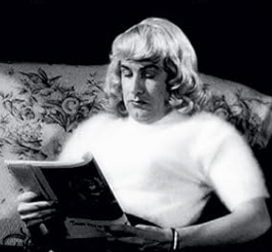
When I was a young kid, I sometimes watched what I later learned were horror and sci-fi B-movies on TV shows like Chiller Theatre. I have a fond memory of one in particular that especially terrified me at the time. It was titled Plan 9 from Outer Space, and it turned out to be filmmaker Ed Wood’s crowning achievement. I happened to think of this again recently, and coincidentally I also needed to create a post for this blog – so, here we are!
You’ve probably heard of Ed Wood, an alcoholic transvestite labeled by many as Hollywood’s worst filmmaker ever. He produced, wrote, directed, and/or acted in numerous low-budget horror, sci-fi, western, crime, and sexploitation films that were rife with clumsy dialogue, poor acting, technical issues, and cheesy effects. But while he struggled financially and suffered critical derision during his lifetime, he has posthumously attained cult status. Today, Edward D. Wood Jr.’s films are celebrated in some quarters for their unintentional humor, eccentric style, and passionate exuberance.
‘Eddie’, as his wife Kathy called him, was a crossdresser with a fetish for angora sweaters; but despite that, his alcoholism, and their poverty, she stayed with him until his death in 1978 at the age of 54. His directorial film debut was 1953’s Glen or Glenda, a semi-autobiographical drama that explored issues of gender identity and crossdressing. He also starred (credited as ‘Daniel Davis’) as a transvestite struggling with an angora addiction in this box-office bomb, which featured some inscrutable narration by the famous horror actor Bela Lugosi, Ed’s personal hero. Lugosi, in the drug-addled declining years of his life and career, would be involved in subsequent Ed Wood projects as well.
Following Jail Bait, a 1954 crime melodrama, Lugosi starred for Ed as a mad scientist in 1955’s Bride of the Monster. Then came Plan 9 from Outer Space (1957), Ed’s most famous / infamous film, which was a story about space aliens resurrecting our dead in order to subdue humankind. This film was quintessential Ed Wood – a wild blend of science fiction and horror with cardboard graveyard sets, awkward dialogue, a patchwork story, pie-plate flying saucers on visible strings, day / night continuity issues, and visible boom microphones, to name a few notable problems. To add to its outré mystique, Ed conned the Beverly Hills Baptist Church into financing the film. Lugosi was meant to star in this one as well, but he died during early production. Ed’s wife’s chiropractor, Tom Mason, served as Lugosi’s stand-in, hiding his face with a cape throughout the film. Others in Ed’s loyal troupe of actors and crew included professional wrestler Tor Johnson; actors Paul Marco (who always played a cop) and Conrad Brooks; Dolores Fuller (a girlfriend who later became a successful songwriter); Maila Nurmi (aka the TV horror hostess Vampira); the drag queen Bunny Breckinridge; and The Amazing Criswell, a TV psychic famous for his wrong predictions.
Decades later, Plan 9 was given a Golden Turkey Award for worst film ever made, and Ed himself also got one for worst director ever. But this film’s imagination and unintentional comedy have since allowed it to become a cult classic. There were at the time, and are more so now than ever, scads of cheesy movies that I and others think are worse. Review aggregator Rotten Tomatoes said, “The epitome of so-bad-it’s-good cinema, Plan 9 from Outer Space is an unintentionally hilarious sci-fi ‘thriller’ from anti-genius Ed Wood that is justly celebrated for its staggering ineptitude.” And Plan 9 is NOT included in IMDb’s Bottom 100 list of abysmal theatrically released films.
Ed’s life and filmmaking career were immortalized in Tim Burton’s 1994 biopic Ed Wood, starring Johnny Depp. This film, which won two Academy Awards, covers Ed’s film projects through Plan 9 and is a good resource if you want to know more about him and his films. Like Ed’s own films, Ed Wood is both serious and humorous.
The follow-up to Plan 9 was 1959’s Night of the Ghouls, which due to financial difficulties was not widely released until after it was rediscovered in the 1980s. Other films written and directed by Ed included The Sinister Urge (1960), which explored the pornography industry; and Orgy of the Dead (1965), a horror-themed nudie film. Around this time, he was forced by lack of mainstream backing into mostly working on sexploitation and adult films, such as Orgy, Take It Out in Trade, and Necromania; however, even that source of income soon dried up for him, as did the paltry income from his side hustles of making commercials and industrial trade films.
But not to worry! While you may have heard of Ed Wood’s films, you may not know that Ed had a second career – as a prolific writer of pulp fiction. Seriously, I’m not kidding! And this was how he continued to pay for his booze and kept himself and his wife from starving to death (though they did get evicted now and then when they were unable to pay their rent). Although he was just as inept at writing as he was at filmmaking, Ed cranked out more than 80 cheap pulp novels in the 1960s and 70s, along with numerous short stories and articles for adult magazines (and still managed to occasionally sell a movie script as well). And he was as compulsively creative and uninhibitedly imaginative in his literary career as he’d been during his time as a filmmaker.
Especially in the 1970s, Ed’s literary career focused on speed and volume. He wrote constantly, sometimes producing a full novel in weeks or even days. He often worked for flat fees rather than royalties. This meant he needed to write continuously to pay the rent, buy alcohol, and support himself and his wife. Many of his novels and stories were published under pseudonyms such as Ann Gora (get it?), Dick Trent, Daniel Davis, Larry Lee, Dr. T.K. Peters, and Woodrow Edwards. The numerous pen names allowed small pulp paperback and smut magazine publishers to market multiple books and stories by the same author without oversaturating the space, and they gave Ed freedom to experiment with different genres. They have also made it challenging to collect all of his known literary works and construct a full bibliography.
Genres he worked in included sexploitation and adult fiction, crime and noir, and horror and the supernatural. The majority of his novels were sex‑oriented paperbacks, combining sensational plots with explicit content. His writings often explored themes of crossdressing, gender fluidity, fetishism, voyeurism, and sexual guilt and shame. Some of them also included reflections on alcoholism, masculinity, and nostalgia for his lost Hollywood dreams. His horror stories often featured occult rituals, haunted houses, monstrous transformations, and psychological breakdowns (as did many of his films). Some of his more notable novels were Killer in Drag (1963), Orgy of the Dead (1965, a novelization of his film), Death of a Transvestite (1967), and Saving Grace (1975). There were dozens of other adult novels with titles such as Purple Thighs, The Sexecutives, The Perverts, Devil Girls, and The Gay Underworld. His literary career, though obscure, was arguably more prolific than his film career.
When Ed died, he’d been completely forgotten by both the literary and film worlds. But as turned out to be the case with his notorious films, Ed’s literary output has since also achieved cult status. The resurgence of interest in both Ed’s films and his writings began with the publication of Rudolph Grey’s Nightmare of Ecstasy: The Life and Art of Edward D. Wood Jr. in 1992, and the release of Burton’s Ed Wood film in 1994 (which was inspired by Grey’s book).
Today, Ed’s publications have become collectors’ items, valued for their rarity and their unique place in American pulp history. His literary career, once dismissed as hackwork, is now recognized as a vital part of his creative legacy. Though derided in his lifetime, his writings now stand as a testament to his relentless creativity. Cornell University owns an extensive collection of his published works.
So – who knew, right? Well, I didn’t anyway, until well after his demise. If you want to know more about Ed’s life, the Burton film and Wikipedia are good places to start. If you’re specifically interested in Ed’s literary career, most of his novels are hard to find; but Blood Splatters Quickly and Angora Fever are easily available and are good collections of his short stories, and they contain informative forwards by Bob Blackburn, a friend of Kathy Wood.
Although he had precious little of both money and talent, Ed was dedicated enough to his storytelling passion to try to do it all anyway, right up to the day he died; and despite his shortcomings, I find that both admirable and inspiring.
R.I.P. Ed Wood! Eddie, we hardly knew ye…
FULL DISCLOSURE
I have the Ed Wood film, the short story collections, and a couple of his novels – plus a box set of Ed Wood movies, which includes the documentary film The Haunted World of Edward D. Wood Jr.
I guess there’s no accounting for taste.
😊
 Threads that Bind
One response to “A Study in Angora”
Thanks for bringing Ed Wood back to life for us, even if only in our memories, of course. I know little about him, but to me he was misunderstood. What I admire most about him — and what I’m a little jealous I didn’t do myself — is that he followed his passion right to the grave.
LikeLike