How The Victorians Celebrated Death, and What I Learned From This Macabre Tradition
Avery Vane, Avery Vane
Wicked, twisted, and insane
Killed his wife and ate her brain
Then killed his son and did the same
When I wrote this verse for my short story The Complications of Avery Vane (published in the Scribblers’ Den Anthology), my goal was simple: to make Avery feel like like a mythic figure—a bogeyman whose crimes might echo in the imagination long after the story ends.
And to do that, I borrowed from a cultural tradition far older and darker than my own invention: the Victorian habit of turning murder into rhyme.
Murder in Verse
Victorian Britain had a macabre talent for dressing atrocity in sing-song rhythms. Murder wasn’t only news—it was entertainment, folklore, even playground chants. By compressing horror into rhyme, the Victorians transformed killers, their crimes, and their victims into folklore.
Take the famous Radlett murder, which involved the brutal murder of William Weare in 1823. The crime received a lot of attention, and Weare’s death was immortalized in this simple ballad.
His throat they cut from ear to ear,
His brains they battered in,
His name was Mr. William Weare,
He lived in Lyon’s Inn.
Then there’s the infamous Mary Ann Cotton, the Victorian serial killer suspected of poisoning as many as 21 victims, including 11 of her 13 children and 3 of her 4 husbands, in order to claim their life insurance. Children themselves were known to chant:
Mary Ann Cotton,
She’s dead and she’s rotten,
She lies in her bed
With her eyes wide oppenSing, sing, oh, what can I sing?
Mary Ann Cotton is tied up with string.
Where, where? Up in the air,
Selling black puddings a penny a pair.
Even Jack the Ripper, the dark celebrity of Victorian London, was celebrated in verse. One infamous rhyme is written from his POV in the style of the notorious Ripper letters.
I’m not a butcher, I’m not a Yid,
Nor yet a foreign Skipper.
But I’m your own light-hearted friend,
Yours truly, Jack the Ripper.
And then there’s the chilling Scottish verse about the body-snatchers Burke and Hare, who went on a killing spree to attain fresh corpses to sell to the anatomists for dissection:
Up the close and doun the stair,
But and ben wi’ Burke and Hare.
Burke’s the butcher, Hare’s the thief,
Knox the boy that buys the beef.
This is to say nothing of more popular nursery rhymes, like Ring Around The Rosie, Three Blind Mice, or Mary, Mary, Quite Contrary, each of which have dark hidden meanings beyond the lyrics’ surface meanings.
What unites these rhymes is their strange dual purpose: they make light of the crime and at the same time immortalize it. By reducing horror to verse, the Victorians made murder easier to talk about—yet harder to forget. The rhyme travels farther than the facts, thereby becoming folklore.
That was my intention with Avery Vane. By giving him his own rhyme, I wanted him to step out of the page and into myth, to join that same chorus of monstrous names whispered in rhyme. Did Avery really kill his wife and child and eat their brains? If not, then why do the children sing about it?
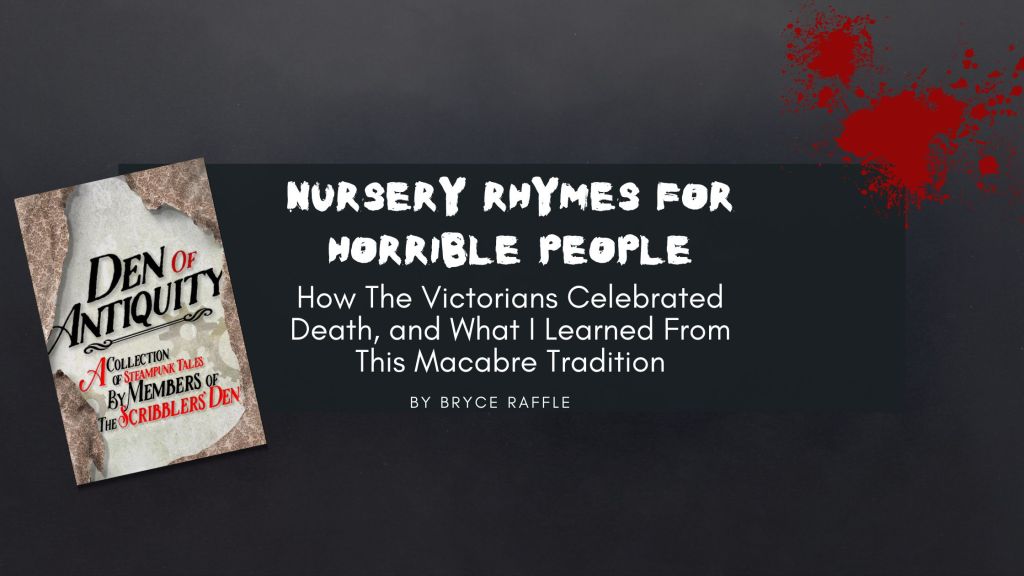
If you’d like to read The Complications of Avery Vane, which won the P&E Readers’ Choice Award for Best Steampunk Short Story in 2016—and explore stories from a host of other talented writers—be sure to pick up Den of Antiquity, a Scribblers’ Den Anthology.

Note about my sources for the rhymes: credit to Judith Flanders’ wonderful book, The Invention of Murder: How the Victorians Revelled in Death and Detection and Created Modern Crime.
 Threads that Bind
3 responses to “Nursery Rhymes For Horrible People”
When famous people die, especially through unnatural causes, there is always a cottage industry in tasteless jokes that springs up, much more widespread in the age of the internet. I once read a psychologist whose opinion was that these are coping mechanisms to help us deal with the fact that we aren’t going to see Princess Di or John Lennon ever again. Could this be the same thing at work… or were these people just asshats?
As to that book he’s promoting, I highly recommend it. The Complications of Avery Vane is worth the price alone, and the other stories, some by contributors to this website, multiply the value. Come take a ride; you won’t regret it!
LikeLiked by 2 people
Very interesting! I took Jack’s advice and bought the book, as it sounds like my cup of chamomile.
LikeLiked by 2 people
Excellent! I am sure you will enjoy Jack’s, William’s, and David’s stories in particular.
LikeLiked by 1 person