Today, I return to the wonderful and weird world of horror comics. As I noted in my last post on this subject, I’ve long been a fan of the medium. So far, I’ve written two comic book scripts and published one of them. Even though I’m not a prolific comic book author, I’ve found that reading comics has helped me be a better writer of short stories and novels. Sometimes I think it simply helps to take a look at writing in a different medium than the ones you read and write more often.
The Familiar World Turned Upside Down
Back in April, I discussed DC Comics’ title Scooby Apocalypse, which is an excellent example of this horror genre. Take familiar, comfortable characters such as Scooby-Doo and the gang, then throw them into a truly frightening situation such as a zombie apocalypse. To be clear, this idea does not require the use of previously established characters. Weird westerns in general are an example of this trope. The brave sheriff rides into town only to find it beset by demons, for example. In science fiction, a brave starship crew can find their vessel turned into a nightmare by the introduction of a homicidal alien, or a mysterious, implacable entity. The key is to set up the reader’s expectations with a world they think they know and then toss in something truly horrific.

A great example of taking a familiar world and adding horror elements is Afterlife with Archie, which ran back in 2013. The story opens with Archie’s pal Jughead going to visit Sabrina the Teenage Witch. It turns out, Jughead’s beloved pooch, Hotdog has died. Sabrina asks her aunts, who are also witches, for help. They deny her because horrible things come from resurrecting the dead. Still, Sabrina feels sorry for poor Jughead and tries to help. That’s when all goes wrong. Hotdog comes back as a zombie dog and bites his master. Zombie Jughead then begins spreading the plague throughout the town of Riverdale.
When I was growing up, Archie comics were safe fun. They imagined teenagers getting up to various silly antics and having rather mild teen angst. They worked largely because of some decent comedy writing. Afterlife with Archie works precisely because the characters haven’t changed at all. They are the same people they always were, just put into a dark and tragic situation that gets seriously out of hand. The lesson here is that when you create a character, get to know them. Understand their good and bad traits. When you bring in your element of horror, whether it be magical, monstrous, or psychological, allow your character to be themselves as confronted by that situation. The interest for the reader is seeing how your character adapts to the situation thrown at them. Is there a breaking point for your character? What happens when they reach that point? That can be an exciting thing to unlock when writing horror.
The Adaptation
Finally, I thought I’d discuss the adapted work. This could be the comic adaptation of a novel or a movie. Adapting a book as a comic can be an exciting way to see how an artist envisions your favorite characters. Adapting a movie as a comic often allows the writer and the artist to explore aspects of a story that didn’t appear on screen. A brilliant comic book adaptation of a movie is Alien: The Illustrated Story written by comic legends Archie Goodwin and illustrated by Walt Simonson. The art is lovely and you learn a little more about the alien and the crew’s relationships with one another.
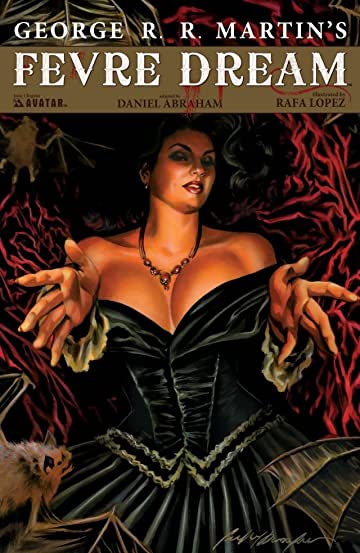
Another brilliant comic is Daniel Abraham’s adaptation of Fevre Dream by George R.R. Martin. Starting in 1857, Fevre Dream tells the story of Abner Marsh, owner of a small steamboat company in St. Louis, who lost most of his boats the previous winter when they were crushed by ice during an unusually harsh winter. A stranger named Joshua York shows up on his doorstep and offers to buy half the company and gives Abner enough money to build his dream steamboat, which Abner calls the Fevre Dream after the river which flowed by his home town. The Fevre Dream sets off down the Mississippi with Marsh and York serving as co-captains. It soon becomes apparent that York only appears at night. What’s more, York insists that the steamboat make many stops on its journey where he will disappear for days at a time. Meanwhile, on a plantation near New Orleans, we meet Damon Julian, leader of a vampire nest. A human thrall named Sour Billy Tipton buys slaves and brings them to the plantation for the vampires to drain dry. It soon becomes clear that Marsh, York, and Julian are heading toward a confrontation.
Daniel Abraham, who adapted the novel into a comic book script, is one half of the team who writes the Expanse novels under the name James S.A. Corey. He did a good job of paring the novel down to its essence and hitting the key plot points. In a comic book, the art needs to do a lot of the heavy lifting of conveying the story’s emotions. At some level, a comic writer’s job is to give the artist all the tools needed to show the story to the reader. Overall, the art did seem to capture the emotions I felt when reading the novel. I did catch a couple of places where it seemed like important plot points were mentioned in passing and if I hadn’t known they were important from the novel, I might have missed them in the comic. This is a challenge in comic book writing because you have to be so minimalist that you have to make choices about what to emphasize and what not to. I might have made a different choice, but without more experience than I have, I don’t know if it would be a better choice.
When I adapted a chapter of my novel Dragon’s Fall: Rise of the Scarlet Order vampires I asked for help from a friend who has done “letters” on several comic titles. The letterer not only lays out the word balloons and text panels, but assures that they’re arranged so your eye follows them in the correct order. It’s often not the most glamorous job, but it’s a critical one to get right. You can begin to realize that if you read comics written nearly a century ago before the letterer’s art was perfected.

My adaptation originally followed my story point-for-point as it appeared on the page. My friend pointed out that while it worked in prose and worked as a chapter, it didn’t stand alone and make an engaging comic. He had me rearrange some scenes and tell some of the end at the beginning. Introduce one of the characters and have him step back and tell the story. In my case, I also used a “familiar character.” My familiar character was Queen Guinevere from Arthurian legend in a story set long after Camelot’s fall. This immediately built some interest. What had Guinevere been doing all this time? What was she like as a character outside of the Camelot story? I gleaned what I could from the familiar stories and legends and then built from there. If you’d like to see how successful I was, you can learn more about the comic at http://davidleesummers.com/Tales-of-the-Scarlet-Order.html
The important and final lesson here is that we all need feedback and support to help us grow as writers. I hope these two posts about horror comics have given you some fun new books to explore and some new places to look for inspiration. As always, let me know if you have some favorite horror comics. I’m always looking for that next great read!
 Threads that Bind