Happy October! I hope everyone has fun plans for Halloween. In keeping with the season, I thought I’d spend a little time exploring the origins of one of the season’s classic monsters, the vampire. Now, vampires have their origins in folklore and legends from around the world. Sometimes it’s hard to separate an oral legend from a good yarn, but we do know that vampires started showing up regularly in poetry during the eighteenth century. So, perhaps it’s not surprising that the first vampire story we still have today is tied to a poet and that poet is none other than Lord Byron.

As I mentioned back in July, the modern horror genre owes much to a gathering in May 1816 where Mary Godwin, Percy Bysshe Shelley, Lord Byron and Lord Byron’s doctor, John Polidori, gathered and challenged each other to tell scary ghost stories. The most famous of those stories would become Mary Shelley’s Frankenstein. Another was a story called The Vampyre. As noted in the earlier post, we now know that the text for The Vampyre was written by Polidori. However, its exact origins are a little less clear, partly because early editions actually credited the story to Byron. Some suggest that Byron told the first version of the story back in May 1816 and Polidori expanded on it. Others suggest the story was always Polidori’s, but it was published under Byron’s name to give it wider appeal. Either way, The Vampyre became the first vampire tale in print, appearing in April 1819.
The Vampyre tells the story of a wealthy young man named Aubrey who decides to travel Europe with the mysterious Lord Ruthven, who proves to be the titular vampyre. The story establishes many of the familiar vampire tropes. Ruthven is an aristocrat who seduces his victims. In keeping with Garrett Dennis’s post last week, eroticism has been part of vampire storytelling since the beginning! Ruthven can heal quickly from even mortal wounds. In an example of a “lost” vampire trope, moonlight seems to speed the process.
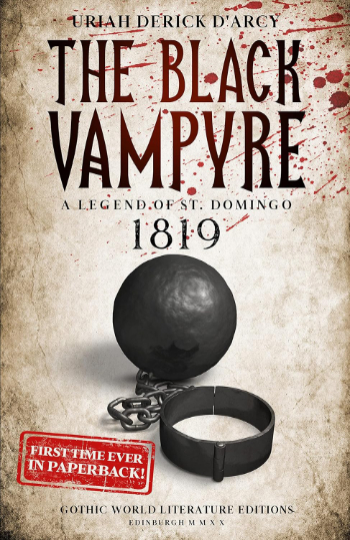
As it turns out, the first American vampire story, and the first story to feature a black vampire was also published in 1819. This story was known as The Black Vampyre and the piece was written as a critique of slavery and white slave holders. The introduction makes a tongue-in-cheek reference to Polidori’s novella as The White Vampyre. The story was published in New York and set in Haiti. The author is credited as Uriah Derrick D’Arcy, which is a pseudonym. Most scholars believe the work was written by Robert C. Sands in collaboration with Lydia Maria Child. However, some believe the author was Richard Varick Dey.
In The Black Vampyre, a young enslaved person is killed by the villainous plantation owner, Mr. Personne. The young man soon comes back as a vampire through Haitian Obeah magic, mortally wounds Mr. Personne, and takes his child to raise as his own. Years later, the young black man returns in the guise of a prince and seduces Mr. Personne’s wife, Euphemia, and then takes her to the graveyard to bring the plantation owner back as a vampire. The point of the story is to suggest that humans who “drain the life” out of other humans by working them to death for their own wealth and comfort are no better than vampires themselves. In this world, aside from their intelligence, the vampires almost resemble modern zombies more than vampires, especially given that the vampires can sustain themselves by eating any part of a dead man, not just drinking blood. That noted, this is the first fictional story I’ve encountered where vampires were dispatched with wooden stakes through the heart.

Finally, I’ll wrap up this little survey of early vampire fiction with a journey to France and an 1836 French novelette called “La Morte Amoureuse” by Théophile Gautier. The title literally translates to “The Dead Woman in Love.” The most common English translation of the story was done by one of my favorite nineteenth century writers and collectors of weird tales, Lafcadio Hearn. You might know him best as a collector of Japanese ghost stories. The 1964 film Kwaidan is adapted from one of his anthologies. Hearn’s translation of Gautier’s vampire tale is often given the name of the story’s vampire, Clarimonde.
“La Morte Amoureuse” tells the story of a young priest who is seduced by the vampire Clarimonde. She leads him into a double life where he’s a priest by day and a suave Venetian gentleman by night. The story becomes a fascinating exploration of the boundaries between the real world and the world of dreams. One night, Clarimonde slips our priest, Romuald, a mickey. He dumps it out and feigns sleep. Later, she turns up and pricks him with a needle, sustaining herself with just a few drops of his blood. This was fascinating in that it’s an early example of a vampire who doesn’t need to kill to survive. And yet, Romuald’s superior is unhappy that the young priest has been seduced and must hunt down the vampire. This becomes the first story I’ve seen where a vampire was dispatched with holy water.
These three stories are all in the public domain. You can find “Clarimonde” and “The Vampyre” at Project Gutenberg. There’s a free copy of “The Black Vampyre” at http://jto.common-place.org/wp-content/uploads/sites/2/2019/08/Black-Vampyre-for-JTO.pdf
Through these stories, we see vampires as predators, sometimes used metaphorically to point out real predators in society. Right from the beginning, we see the erotic side of vampires very much in place. Now these stories are from the early nineteenth century, so they’ll seem quite tame to modern readers, but there’s no question these vampires are sexual creatures. As C.W. Hawes pointed out a while back, these vampires won’t be harmed by sunlight, but they do seem to get up to most of their seduction and blood drinking at night.
If you enjoyed this survey of early vampires, I’ll be taking a closer look at each of these tales over at https://davidleesummers.wordpress.com starting around Halloween. Have you encountered an early vampire story that stuck with you? If so, I’d love to hear about it and I might even take a closer look at it soon!
 Threads that Bind
3 responses to “The Origins of Vampire Fiction”
Another interesting history lesson – thank you! I knew about the Polidori/Byron book (though I haven’t read it), but not about the others mentioned here – other than ‘Frankenstein’, which I have read (but not a vampire story). Keep the lessons coming! Although I dabble in writing horror, I’m not as well-informed about the history of the genre as I probably should be. Oh, by the way, there’s an interesting partial history of sorts by Grady Hendrix (‘Paperbacks from Hell’); it’s mostly pulp-oriented, but it’s a fun read.
LikeLiked by 2 people
Another great horror “documentary” is Danse Macabre, a 409-page study of the genre by Stephen King first published way back in ’81. I must confess to never being a big King fan, but no one can deny that the guy knew his trade, and this history tome is one of the best horror reads I’ve ever enjoyed.
LikeLiked by 1 person
Garrett and Jack, thank you both for your thoughts and the recommendations. I’ll definitely take a look for Stephen King’s Danse Macabre (which has been on my radar, but I haven’t yet read) and Grady Hendrix’s Paperbacks from Hell. I’m a fan of King and Hendrix has been recommended to me for several books by readers whose opinions I trust.
LikeLiked by 1 person