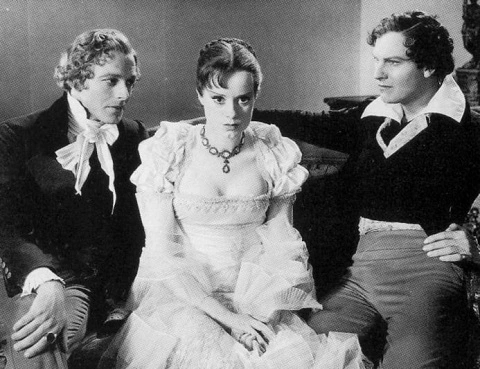
A good case can be made that science fiction and horror were born together during a retreat in May 1816 and two of Britain’s great poets were there for the occasion. The poets were Lord Byron and Percy Bysshe Shelley. Lord Byron’s doctor, John William Polidori, and Mary Godwin, who later married Percy Shelley, accompanied them. During the course of the retreat, a challenge was issued to create the scariest story possible. Mary Godwin’s story was Frankenstein, which many see as the first science fiction novel, but can also be seen as horror. Another story that came out of that retreat was The Vampyre by John Polidori. Though it’s not as famous as Frankenstein, The Vampyre did influence Bram Stoker’s novel, Dracula. Here we see the moment as dramatized at the beginning of James Whale’s The Bride of Frankenstein.
My own writing owes a lot to that retreat in 1816. I’ve been a fan of vampires since I first read Dracula when I was ten years old. My interest grew in the 90s, when I first worked at Kitt Peak National Observatory. Several of us who operated telescopes called ourselves the “vampires of the mountain” because we were only seen at night. I discovered such writers as Anne Rice and Suzy McKee Charnas around that time. A few years later, a friend of mine, Janni Lee Simner, was visiting me at my home in Las Cruces, New Mexico. Las Cruces literally means the city of the crosses and Janni pondered what a vampire would do in a town where there were crosses absolutely everywhere. She wasn’t interested in writing a vampire story at the time, but said if I came up with a story to go with the idea, I was welcome to it. A few weeks later, I wrote the story “Vampire in the City of Crosses”, which soon sold to Margaret Carter’s magazine, The Vampire’s Crypt.
In Mary Shelley’s novel, the central problem is that Dr. Frankenstein has created new life without fully understanding the consequences. As my vampire stories evolved, I began exploring that same idea, which gave rise to the novel Vampires of the Scarlet Order. In the novel, a group of vampire mercenaries confront scientists who are trying to create a new breed of vampires that can be used as super soldiers. I’m currently working on a sequel that further explores what it means to push the boundaries of science and how that could have horrific consequences called Ordeal of the Scarlet Order.
Just as Mary Shelley benefited from the company of Lord Byron and her husband, Percy Shelley, I have benefited from working with other writers. One in particular, is Lee Clark Zumpe, who shares my passion for vampires. Over the years, Lee and I admired each other’s works in magazines such as The Vampire’s Crypt, Night to Dawn, and Blood Samples. Several years ago, Lee and I pulled several of our vampire flash fiction pieces together into a collection called Blood Sampler: Subtle Sips and Spicy Shots. The book is now available from Hiraeth Publishing.
Lest you think my horror is limited to vampires, that same stormy spring that inspired Mary Shelley and John Polidori helped to inspire my novel The Astronomer’s Crypt. As I say, I work at an observatory and, of course, stormy nights are bad for astronomy. What’s more, the observatory where I work is housed in a building with many laboratories, photographic dark rooms, machine shops, storage rooms, and empty corridors. Now imagine if the power went out and you were trapped in such a building with ghosts and a monster believed to have been destroyed by Apache warriors centuries before. Would scientists know how to cope with this situation? Would anyone?

I hope you’ve enjoyed this sampling of things I’m doing and how they’re tied to one of the great moments in science fiction and horror history. To learn more about me and my writing, visit http://www.davidleesummers.com
 Threads that Bind
7 responses to “Going Back to Horror’s Roots”
Another stellar history lesson from our resident astronomer, and thank you for this delectable treat. Of course, most sci-fi and horror writers worth their salt are aware of the foundation laid by these stormbound friends’ impromptu writing contest. We owe them much, or perhaps we owe it to that unseasonal spring storm. Incidentally, you’ve inadvertently given away your secret: In your final paragraph you state that “that same stormy spring that inspired Mary Shelley and John Polidori helped to inspire my novel The Astronomer’s Crypt.” I had no idea you were alive in 1816! It’s no wonder your vampire stories are so compelling; who’d have thought that they were autobiographical?
Seriously, though, I’m not a huge fan of the vampire story, though I did have fun with Buffy, but her show was about every monster known to myth and legend, and incidentally a few of them were vampires. But let me take this opportunity to once again tout one of the best horror stories I’ve ever read, The Astronomer’s Crypt. This is a personal favorite of mine and I never miss an excuse to promote it. If you are a fan of a good, chilling spooker, you cannot afford to miss this. It is to horror what XCom is to video games. To quote a review from XCom’s early days, “If you aren’t playing XCom, you aren’t really a gamer, you’re just some jerk with a computer.” Same deal with Crypt. Buy it. Read it. It will be the best handful of pocket change you ever spent!
LikeLiked by 2 people
Jack – I will plead the 5th about whether or not I was, in fact, alive in 1816. Though, I must say, after spending a day pulling cables through a telescope during summer maintenance shutdown, I certainly feel that old. What I will say is that as a reader, I absolutely did experience that spring storm through the writings of those who did experience it. The best writers will transport you to times and places you otherwise could not have visited.
Thanks so much for the good words regarding The Astronomer’s Crypt. As I’ve said before, your endorsement means the world to me. I think the one thing people like about my vampire stories is that they see the time I spent reading the folktales and incorporating old vampire lore into my vampires. Plus, I add in a healthy dose of real history and serious action. My vampires don’t tend to sit around brooding. They’re busy kicking butt and taking names. 😉
LikeLiked by 1 person
Reblogged this on Negatrite! and commented:
I submit the words of a fellow author and friend you should get to know
LikeLiked by 2 people
David, I am a fan of your work but have yet to read either of these much to my shame. Will have to correct that! In the meantime, I love the roots of horror and science fiction being Mary Shelley. I love that it’s a woman, a story sort of told off the cuff during a storm, and set a prescient morality tale that haunts the world to this day. I used to love the vampire asthetic (more than I’ll admit to here) and stories, but it dimmed for me over time. I’m glad your mind can breathe new (un)life into that scene.
LikeLiked by 2 people
Thank you, William. I agree, it’s very cool that Mary Shelley is, in a real way, the mother of both science fiction and horror. While I think good cases can be made for earlier works in both genres, Shelley gave us the scary, thoughtful science fiction novel that stood the test of time and inspired many people. I hope if you decide to give my vampires a try, you’ll like what you see. There’s a definite nod to classic aesthetic, but as I say in my reply to Jack, I think I bring something new to them as well.
LikeLiked by 1 person
Another interesting history lesson; thank you for that. I suspect that a lot of writers don’t know enough about the roots of their genres – but they should, and I think posts like this one can help. You’ve also piqued my interest in ‘The Astronomer’s Crypt’, which I’ll read sometime even though you yourself might be a centuries-old vampire. I don’t care what folks do behind closed doors, none of my business… 🙂
LikeLiked by 2 people
Thanks on all fronts, Garrett. Much appreciated and I hope you enjoy The Astronomer’s Crypt if and when you do delve in! 🙂
LikeLiked by 1 person