As a writer of vampire horror, I find it useful to take a look at what makes them an effective source of horror. This is not necessarily intended to be a definitive or exhaustive list. Also, just because I cite a book under one category doesn’t mean it won’t fit under other categories as well. However, I hope it sparks some thought and maybe you might think of other examples to mention in the comments.
Vampires as the “other”

Carmilla by Sheridan Le Fanu is a vampire novella that predates Bram Stoker’s Dracula. The illustration shown here was done by Michael Fitzgerald for the first publication in the January 1872 issue of The Dark Blue. As a parent, many of my greatest hopes and fears center around my children. Will they be healthy and happy? Did I give them the tools to be successful? Are their friends people of good character who will support them? In broad strokes, Carmilla can be seen as the story of a young woman who is led astray by her Goth lesbian friend. This might not seem so terrible today, but must have seemed truly horrifying back in 1872.
In a very real way, Dracula capitalizes on similar fears. It tells the story of a foreigner who arrives and leads one young woman onto a dark path before killing her, then begins leading another woman down the same path. Another novel that takes the terror of the vampire as terrifying “other” to even further heights is Kim Newman’s Anno Dracula, in which the foreign count not only becomes the neighbor of upstanding British citizens, but takes over as their monarch!
Both Carmilla and Dracula involve seduction behind closed doors, often at night when good people aren’t readily available to rescue the victims. Stated this way, it sounds old-fashioned and Victorian, far removed from more empowered people, but in both cases the vampire is able to elude the heroes and, in Dracula’s case, is quite capable of defending himself. It’s been pointed out that the Victorian vampire has a strong resemblance to more recent stories of alien abduction, where a creature shows up when the victim is alone and defenseless and then does untoward things with them. Hold that thought because we’ll come back to it.
Vampires as a plague
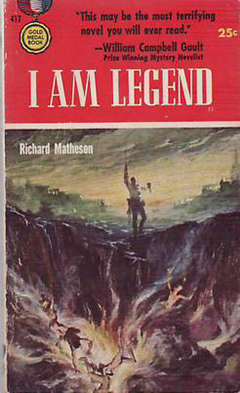
One idea that often turns up is that vampires themselves are a plague. One of the most famous examples I know is Richard Matheson’s classic I Am Legend which tells the story of Robert Neville, who is living in a post-pandemic world, attempting to fend off hordes of his one-time neighbors who have become zombie-like vampires. Here, the vampires are not creatures of seduction, but a force with no apparent aim other than to feed on the victim.
Another novel that follows this approach is Baltimore, or the Steadfast Tin Soldier and the Vampire by Mike Mignola and Christopher Golden. This one starts out during World War I when a the title character, Lord Baltimore, unwittingly unleashes a plague of vampires on the world. Lord Baltimore returns home and finds that the master vampire has killed his family. This sets Baltimore on a quest to find the master vampire and kill as many of the monstrous, pestilential vampires as he possibly can.
We are the monster
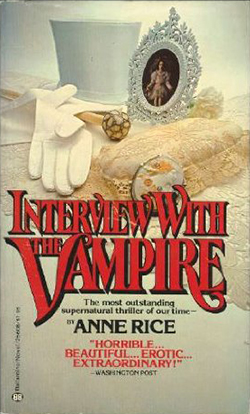
Anne Rice was not the first author to feature the vampire as a protagonist, but she did a lot to popularize the idea when she released Interview with the Vampire. In the novel, Louis de Pointe du Lac is made a vampire and realizes that while he’s immortal and powerful, he must take lives in order to be well. Anne Rice doesn’t soften the monstrosity of vampires. They prefer human victims and they kill. She also doesn’t flinch away from the fact that humans are often cruel and kill other humans. For her, the vampire becomes a metaphor for exploring how we endure even when we’re forced to experience and do terrible things. The horror doesn’t come from facing the monster. The horror stems from being the monster.
Other classic novels that follow this idea are Suzy McKee Charnas’s The Vampire Tapestry, which examines three episodes in a vampire’s life from his point of view and Chelsea Quinn Yarbro’s Hotel Transylvania, which imagines the real-life Comte de Saint-Germain as a vampire who attempts to live the best life he can in spite of his existence as a vampire.
Combining the tropes

Perhaps one of my most surprising revelations was realizing that The War of the Worlds by H.G. Wells is a vampire novel. After all, the Martians come to Earth, take over, and then begin harvesting humans and start drinking their blood. They are the literal vampire from another world. They are a plague of monsters overwhelming the planet. Over the course of the novel, Wells shows us the darker side of humanity and in the end it’s humans who become the monsters by inadvertently unleashing a virus on the Martians and killing them. The illustration in this section is a vintage illustration from the novel by Henrique Alvim Corrêa.
I enjoy exploring all of these tropes and concepts in my vampire fiction. I’ll admit, I’m not terribly scared of the “other” whoever that might be, but I recognize many people are and their reactions to that fear does scare me at times. We all just lived through a pandemic and have experienced the dread and worry that it brought. I hope I’m not a monster, but I’ve done things I’m not proud of, and I have met people who have done terrible things. These all feed into my stories. Let me know if there are other vampire-related themes I missed that you enjoy or any books you’d recommend. If there’s a book or two on this list you haven’t read, hopefully I’ve piqued your curiosity. If you want to learn more about my vampires, visit http://www.davidleesummers.com/books.html#scarlet_order
 Threads that Bind
2 responses to “Why Are Vampires Scary?”
What a fantastic dissertation! I’m surprised this hasn’t sparked a long thread of comments but let me start the ball rolling.
DISCLAIMER: I am not trained, lay or formal, in the field of psychology and, beyond dealing with the lunatics I encounter in my daily life, have no practical experience. Nonetheless, to be a writer you must de facto be an observer, and this is a theory I’ve developed over decades of observation:
A dog lives by its teeth. This is why they gnaw, and if you live with a dog, you’re very familiar with chewed-up items; that’s your dog keeping its primary survival tool ready for instant use. Likewise with cats. Cats live by their claws, and if you share your home with a cat, you probably have very few possessions that lack the marks of the little tiger preparing for the hunt.
Well, as a human, your primary survival tool is that big brain that is, as you read this, making sense of these ridiculous squiggles marching down the page. So how do you keep that brain sharp? It can’t gnaw, it can’t claw, it can’t run wind sprints, so in order to keep it sharp, you have to let it off the leash from time to time to go exploring, and those explorations are guided by the society in which it lives.
When the ancient Greeks talked about Pegasus and Hercules, these were to them real creatures that they might someday meet in their daily lives; demigods, caused and created as it were by the religion they believed in. Victorians believed in a rich and not-too-distant afterlife. They consulted mediums and went to seances, and for a Victorian to believe he’d seen a ghost, a fairy, or even a vampire, was completely in line with the society he was steeped in.
We’re very sophisticated these days, and only the, let’s say, less intelligent among us believe in such nonsense. Instead, we steep ourselves in alien contacts of various forms, urban monsters — our local version is the Proctor Valley Monster — and of course the ever-popular government conspiracy, none of which can be proven, but “My brother-in-law knew a guy who had a friend who served in Iraq with a guy who personally witnessed…”
These are all examples of people who have let their brains off the leash and then been unable to call them back, but doing this in a playful way while understanding that these things aren’t real — i.e., by reading sci-fi and horror, and watching shows about the same subjects — is a healthy form of keeping the mind sharpened if you will. I can generally tell when I meet someone who doesn’t. They’re wound up tight, they’re unfriendly, they’re irritable, and they’re likely to explode in unpredictable ways.
And that’s my theory on this subject. Is it wrong? Most likely, but I’ve held it for several decades now, and I have yet to see a case to make me think so. What do YOU think?
LikeLiked by 1 person
I like you’re theory and I think it actually dovetails nicely with my thoughts above. The vampire tropes and concepts I mention above are really just examples of the ways people have playfully explored these ideas over time.
Of some interest, and tied to your comment about the Greek gods, a friend of mine wrote a great book called Jerry Springer as Bulfinch, which explored how the ancient myths were all about the ways love can make us do totally crazy things, just like the Jerry Springer show did. So yes, the myths were a playful and sensible way to explore those ideas as opposed to bringing people on stage to act out their worst selves in front of an audience!
Vampires can serve much the same function. You can explore these ideas and more. I also like using the vampires’ immortality as a way to give some perspective on issues I’m writing about… that part’s not particularly scary, but it’s still good mental exercise.
LikeLiked by 1 person